Thursday, 6 September 2012

Only God makes things grow.

The reading from Mass the other day (5th September) from St Paul (Corinthians 3:1-9) brought me to yet another reflection or reading of the icon - especially in the light of Dom Theodore Bailey's window I discovered whilst in West Wales. The line that caught my eye is where St. Paul says 'only God makes things grow'.  We can do do all we can with a seed to help it grow, but we can't make it grow. ( I have tried many times!)  Turning to the icon and Bailey's window it struck me how both uniquely - as far as I know-  introduce nature into the image of the Sacred Heart: both have images of growth.

Sacred Heart by Dom Theodore Bailey

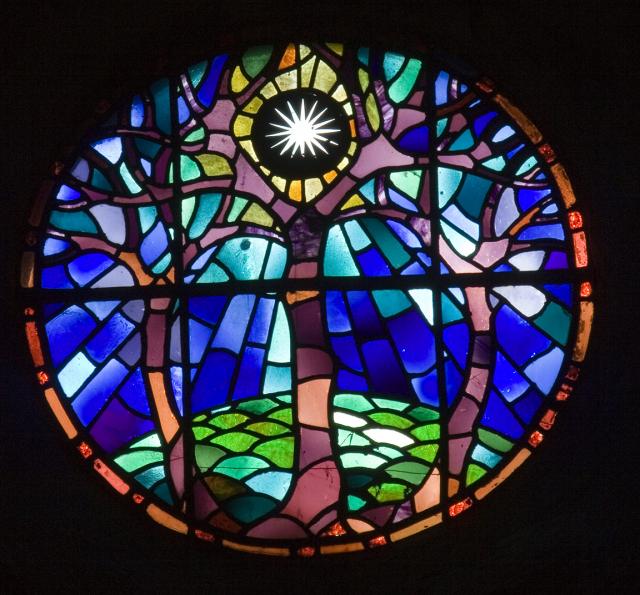
The icon uses the vine, leaves, grapes and animals, and Bailey uses ferns and sunflowers.   As Teilhard was all about seeing Christ in all things and God's love as an energy which fills all creation and pulls all things towards completion in Him, I think this idea of only God  can make things grow  is reflected in both the images.  St.Paul was, of course. very much an inspiration for Teilhard's idea of the Heart of Jesus, but by saying that 'only God can make things grow' we are reminded that we are all dependent on the grace of God.  The icon shows the living water which flows from the heart of the Saviour, nourishing all creation.  In Dom Theodore's window we see plant life blooming at the feet of Christ.  Both images remind us that only God can make us grow: to be devoted to the Sacred Heart is to trust in God's grace.  Without it we cannot grow.  This made me think of another window by Dom Theodore in St. David's chapel on the island of Caldey - which I last visited over twenty years ago! His theme here is the 'tree of life'. Perhaps we understand his (and our) Sacred Heart all the better when we take account of this window.  Can we read the Sacred Heart as the tree of life? The window as described by the Caldey website says that: 'It depicts a threefold tree, possibly symbolising the Trinity and the three crosses on Calvary. When illuminated by the afternoon sun, it gives a stunning sense of the power of the Creator breathing life and light into the world.'   (Go HERE) On this we can turn once again to the poem by St. Edith Stein quoted in the previous blog:


The Tree of Life, Theodore Bailey

In the heart of Jesus, which was pierced,
The kingdom of heaven and the land of earth are bound together.
Here is for us the source of life.

This heart is the heart of the triune Divinity,
And the center of all human hearts
That bestows on us the life of God.

It draws us to itself with secret power,
It conceals us in itself in the Father's bosom
And floods us with the Holy Spirit.

I think that IS what the Sacred Heart in these images prompts us to contemplate. The Sacred Heart as the source of love, light and life.

Monday, 3 September 2012

Saint Edith Stein and the Sacred Heart

The window by Dom Theodore has continued to provided much food for thought and prayer.  It was the feast day of  the great Carmelite saint, St Teresa Benedicta of the Cross - Edith Stein - on the 9th August which brought me right back to Dom Theodore's window and to our icon.  I came across a passage in her  book The Hidden Life   which  seemed to echo what the window is saying.

'The work of salvation takes place in obscurity and stillness. In the heart’s quiet dialogue with God the living building blocks out of which the kingdom of God grows are prepared, the chosen instruments for the construction forged. The mystical stream that flows through all centuries is no spurious tributary that has strayed from the prayer life of the church it is its deepest life.  ' (  See here  )

Reading her work is is apparent how she draws deeply upon the Carmelite tradition of the heart, and how central the Sacred Heart was to her spiritual life.  The evidence of her 'heart spirituality' is much in evidence in her writings.   In 1940, for example, she writes of the 'Hidden life and  Epiphany':


'When the gentle light of the advent candles begins to shine in the dark days of December a mysterious light in a mysterious darkness it awakens in us the consoling thought that the divine light, the Holy Spirit, has never ceased to illumine the darkness of the fallen world. He has remained faithful to his creation, regardless of all the infidelity of creatures. And if the darkness would not allow itself to be penetrated by the heavenly light, there were nevertheless some places always predisposed for it to blaze. A ray from this light fell into the hearts of our original parents even during the judgment to which they were subjected. This was an illuminating ray that awakened in them the knowledge of their guilt, an enkindling ray that made them burn with fiery remorse, purifying and cleansing, and made them sensitive to the gentle light of the star of hope, which shone for them in the words of promise of the "protoevangelium," the original gospel. As were the hearts of the first human beings, so down through the ages again and again human hearts have been struck by the divine ray. Hidden from the whole world, it illuminated and irradiated them, let the hard, encrusted, misshapen matter of these hearts soften, and then with the tender hand of an artist formed them anew into the image of God. Seen by no human eye, this is how living building blocks were and are formed and brought together into a Church first of all invisible. However, the visible Church grows out of this invisible one in ever new, divine deeds and revelations which shed their light ever new epiphanies. The silent working of the Holy Spirit in the depths of the soul made the patriarchs into friends of God. However, when they came to the point of allowing themselves to be used as his pliant instruments, he established them in an external visible efficacy as bearers of historical development, and awakened from among them his chosen people. Therefore, Moses, too, was educated quietly and then sent as the leader and lawgiver.'  ( Read here.)

This passage to me helps me to read Dom Theodore's window, but also to read the icon in a new way.   A relationship to Christ in the heart of of creation is one in which the light penetrates the human heart and illuminates it from within: it is an invisible process by which God's presence is experienced in the world.   This sense of humanity being open to the penetration of divine light is very much a theme in Teilhard.   And wherever we look in Saint Edith's work we find  the heart as that point in the universe in which God's light seeks to make a home.   A beautiful example is her poem: I Will Remain With You.


You reign at the Father's right hand
In the kingdom of his eternal glory
As God's Word from the beginning.
You reign on the Almighty's throne
Also in transfigured human form,
Ever since the completion of your work on earth.

I believe this because your word teaches me so,
And because I believe, I know it gives me joy,
And blessed hope blooms forth from it.

For where you are, there also are your own,
Heaven is my glorious homeland,
I share with you the Father's throne.

The Eternal who made all creatures,
Who, thrice holy, encompasses all being,
In addition has a silent, special kingdom of his own.

The innermost chamber of the human soul
Is the Trinity's favorite place to be,
His heavenly throne on earth.

To deliver this heavenly kingdom from the hand of the enemy,
The Son of God has come as Son of Man,
He gave his blood as the price of deliverance.

In the heart of Jesus, which was pierced,
The kingdom of heaven and the land of earth are bound together.
Here is for us the source of life.

This heart is the heart of the triune Divinity,
And the center of all human hearts
That bestows on us the life of God.

It draws us to itself with secret power,
It conceals us in itself in the Father's bosom
And floods us with the Holy Spirit.

This Heart, it beats for us in a small tabernacle
Where it remains mysteriously hidden
In that still, white host.

That is your royal throne on earth, O Lord,
Which visibly you have erected for us,
And you are pleased when I approach it.

Full of love, you sink your gaze into mine
And bend your ear to my quiet words
And deeply fill my heart with peace.

Yet your love is not satisfied
With this exchange that could still lead to separation:
Your heart requires more.

You come to me as early morning's meal each daybreak.
Your flesh and blood become food and drink for me
And something wonderful happens.

Your body mysteriously permeates mine
And your soul unites with mine:
I am no longer what once I was.

You come and go, but the seed
That you sowed for future glory, remains behind
Buried in this body of dust.

A luster of heaven remains in the soul,
A deep glow remains in the eyes,
A soaring in the tone of voice.

There remains the bond that binds heart to heart,
The stream of life that springs from yours
And animates each limb.

How wonderful are your gracious wonders!
All we can do is be amazed and stammer and fall silent
Because intellect and words fail.

And I Remain With You

( See Here. )

I think Teilhard would have loved this poem - as now I do! Saint St Teresa Benedicta of the Cross, pray for all those who seek the Sacred Heart.

Monday, 13 August 2012

Dom Theodore Bailey's Sacred Heart in Pembrokeshire (2)


Having travelled all the way to west Wales I found myself ( mentally at least) having to return to Paris once again!  For if I was to make sense of the stained glass window by Theodore Bailey, in Wales,  we have to wrestle with the French relationship to the devotion and to the image.   As a monk Dom Theodore was a member of a Benedictine  order which had itself played an important role in the history of the devotion.

Arriving in Paris in the early 1920s Dom Theodore would have experienced a high point in the history of the devotion: the great  Basilica had been completed in 1914 and was dedicated in 1919 ( the same year as the founding of  the Ateliers d'art sacré ). George  Desvallières and Maurice Denis's mission to renew and re-vitalize sacred art had obvious implications for the image of the Sacred Heart: the most prominent of all the ‘sulpician’ kitsch art which they deplored.  Dom Theodore was to be greatly influenced by his experience in Paris, but he was not to come back with the same kind of idea or image of  the Sacred Heart as that which he would have encountered in Paris. What we see is in many respects most unlike the work of his teachers.

George Desvallières had, by the time the young man from Caldey came to Paris, executed a number of Sacred Heart pictures.  Two pictures in particular had acquired some notoriety and acclaim prior to Dom Theodore’s visit.   The first, painted in 1905 showed Christ suffering with and for humanity. Jesus is not on a cross, so much hanging, as it were in front of the Basilica which was being built at the time.   It is difficult to imagine a less sentimental representation of the Sacred Heart as Christ is ripping open his chest to expose his wounded heart.  Later in 1919 – after he had (like Henri Pinta) lost a son in the First World War  he painted another Sacred Heart which again radically departs from the traditional image and explores the same theme of the Sacred Heart as a symbol of Christ sharing in the sufferings of humanity: the’ Drapeau du Sacré-Coeur’, for the Church of Notre Dame de Verneuil.  Not much by way of sentiment here, but a powerful portrayal of a Christ who is wholly and completely sharing in the pain of humanity.


Maurice Denis had also completedseveral works on the Sacred  Heart.  These are very different to the approach taken by Desvallières, and seem to focus on the Sacred Heart as a kind of golden glow of divine love.   In this respect they are very much in keeping with the ideas we find in Teilhard, and which he believed was expressed in his Henri Pinta picture.  In his 1894 painting Sacre-Coeur Crucifi  (right) Maurice Denis depicts the Sacred Heart as a golden glow: a light illuminating the darkness.  Later, he produced various versions of the same  image of a crucified Christ with a golden glowing heart upon which rests the Blessed Virgin.  He worked on one of these designs during the time Dom Theodore was in Paris, for the art deco church by the architect Auguste Perret, Notre Dame du Raincy. An oil on canvas version is ( I think) at the Musee du Hieron at Paray le Monial.

When we compare the images of the Sacred Heart by his teachers and that we find in the Holy Name in Pembrokeshire, we see no obvious points of similarity.    Indeed, if anything what we see in Dom Theodore’s window is a reaction against both the kitsch sentimentalism of the standard image but also a reaction against the kind of emphasis on suffering we find in Denis and Desvallières.  Dom Theodore’s Sacred Heart is a very much a monk's image: it is the Sacred Heart as a loving silence.  The Sacred Heart in this window above the tabernacle is a call to enter into the silence: it is a image which tells us that for the artist we have to be meek and humble of heart.  We have to be still and listen to the sound of the Heart of Christ: it is an image which is asking us to close our eyes and be silent.  In this was we can enter into the sacred heart of creation and be open to an encounter with God.   And I think this is what we see in this window: it is a window into the centrality of silence and humility in Benedictine spirituality.   If we desire to enter into the Sacred Heart we have to cultivate stillness and silence in our lives.  Thus although in Paris he encountered the Sacred Heart in terms of suffering and light, the experience of a monastic life led him to portray the devotion  to the Sacred Heart as a devotion to finding space for silence in our lives. This is the only way to understand our own heart and the heart of  God. Be still.  Be silent. Listen. A heart is beating at the centre of creation: it is the heart of Christ.  As a Benedictine Dom Theodore knew that silence is the path which leads to the deep mystery of the heart of the Saviour. To take up this path requires us to be wholly orientated towards the glowing love of God, like the sun flowers which always turn towards the sun, and ( fern-like) ever seeking to become humble of heart.

Well, such were my thoughts.

Sunday, 12 August 2012

Dom Theodore Baily's Sacred Heart in Pembrokeshire (1)


Interesting.  Since the last blog on the Benedictine tradition and the Sacred Heart, I have been in Wales and came across a beautiful and fascinating image by a Benedictine  monk, Dom Theodore Baily (1898-1966) .   Dom Theodore entered Downside Abbey in 1914, and later in 1920 went to Caldey (See HERE)  where he stayed  until 1928 ( when he move to Prinknash and later Farnborough – from 1947) .  In 1922 he went to Paris and spent some time  studying with Georges Desvallières and Maurice Denis at their famous Ateliers d’Art Sacré. (See HERE)  The following year, 1923, he returned to Caldey and was ordained in 1927. Whilst at Caldey, Bailey produced a number of impressive stained glass windows. It was one of these I discovered whilst paying a recent visit to Pembrokeshire.  I have been to the 'Holy Name' in Fishguard before – but never really noticed the stained glass window.  Which just goes to show how blind I was to the Sacred Heart until this icon project.  But now it seems that I see the Sacred Heart in all things and places!   I had come to Pembrokeshire with an eye to making a visit to the Cathedral at St. David’s and generally to explore the ‘Holy Land’ of Wales.  I was not really looking for the Sacred Heart, but it seemed to find me and led me to new paths and avenues to explore, and prompted me to re-trace some old ones.

The window has an ‘iconic’ feel to it - well that is what I immediately thought when I saw it and is clearly operating on a more symbolic level than the usual image of the Sacred Heart – there were a number of the usual sort in the church.  High in the apse of the church, directly above the tabernacle,  the window is a powerful focal point for the congregation and you are naturally drawn to it- sadly a huge cross as been erected one side and rather detracts from the window.  Pity really.   The detail is such that it is only when you  study a photograph of the window that it is possible to appreciate the considerable artistry of  Dom Theodore, and marvel at the way in which he has chosen to represent the Sacred Heart.  Considering the fact that in was produced in the 1920s, when there was so much awful sentimentalized stuff around - precisely the kind of stuff Teilhard disliked -  it is a truly an outstanding piece of  modern sacred art and shows how much the young monk had learnt from his studies in Paris.

The face has none of the characteristic kitchness associated with the traditional type of Sacred Heart.   Christ is not looking up to heaven as is often the case in images of the  Sacred Heart or looking at us in the way in which He is normally portrayed.  It is a strong and powerful face.  The kind of face we see in icons, rather than Catholic traditional representations.  He is wearing the crown of thorns and his garments are purple in part to signify His universal kingship.  ( The feast of Christ the King had been instituted by Pius XI, in 1925.)   His  hands show his wounds and do not point to his heart.  The heart  itself is a simple red centre surrounded by a golden  light or glow.  Christ does not look up to heaven because he is in heaven – as represented by the blue glass.  Neither is he looking at us.  What we see instead is Christ whose eyes are closed as if in a state of prayer or meditation. Perhaps in this he was influenced by the Sacred Heart of another French symbolist (we explored earlier in this blog) who had died in 1916 - Odilon Redon.  In his Sacred Heart Jesus’s eyes are also closed in a very ‘eastern’ way: as if in deep meditation.  One of his teachers in Paris  (Maurice Denis) evidently  knew Redon – indeed Redon painted his portrait in 1903 – so it is not inconceivable that that Dom Theodore would have known of Redon’s Sacred Heart.  Denis himself had painted several pictures of the Sacred Heart, and in the period when Dom Theodore was in Paris, he designed the windows in the Notre Dame du Raincy – designed by Auguste Perret.  One of these depicts the Sacred Heart. Earlier Denis  he had pained a picture of the Sacred Heart Crucified (1894) with a ‘golden glow’.   George Desvallières ( a third order Dominican, like Felix Ville) had also painted pictures of the Scared Heart in 1903 and 1919  and painted several others in later years.  However, what is common in all their Sacred Heart works is, like Theodore Baily’s window, Jesus does not have that (rather effeminate) ‘look’ we associate with the  standard image.  That comes across very clearly when we compare the face of Christ in this window with those of his teachers in the Ateliers d’Art Sacre.  I will deal with this in another post.

Together Denis  and Desvallières set out to challenge ‘l'art St. Sulpice’.   So, the decision by Theodore Bailey to study with them was quite a radical move by the young Benedictine.  The more we look at the window and understand the influence of his experience in Paris in the  Ateliers d’Art Sacre, the more significant becomes this beautiful window.  It deserves to be much better known.

The lower half of  the window is suggestive of so many thoughts and ideas.   It provides so much material upon which we can reflect and I wonder how over the years this window has served to aid the prayer of the faithful who have gathered underneath its gaze.   The artist employs two symbols which are not usually associated with the Sacred Heart: fearns and flowers.  

Ferns are symbols of humility.  Is Dom Theodore’s window asking us to understand that, if we are to be one with the heart of  the Saviour,  we too must be meek and humble of heart?   If we are to grow and unfold as Christians we have to learn from the humble fern.  The fern, of course, grows in the shade and under the protection of great trees.  Is Christ in this window the great tree of life: the crucified one who hung upon a tree at Calvary?  And we are, perhaps, the unfurling fronds: the signs of new life awakening in Christ?  The ferns are, it appears, growing towards the light of the world.  It is significant that the artist uses small newly emerging fearns – all tight little spirals that will grow and complete themselves is this new light glowing at the centre of the window.  Here the Sacred Heart is a centre which is calling to our centre: calling us to unfurl and evolve.

The flowers are more of a problem.   I  am not sure what flowers they are supposed to represent.  At first hey brought to mind the lines in Mathew 6.26: is the artist asking us to remember the flowers of the fields  who sow not neither do they spin?  To be one with the heart of  Jesus we have to trust  God wholly and completely?  In which case is the window asking us to reflecting on the prayers so much associated with the Sacred Heart: “Jesus meek and humble of heart make my heart like unto yours.”.  And: ‘ Sacred Heart of Jesus, I place all my trust in you’.   On  other hand, they do look rather like sunflowers. Reflecting on these I thought that perhaps the artist is using the sunflower as symbol of the soul which, like the sunflower always turns and seeks out the light of the sun?  Is the Sacred Heart the great sun towards which we must grow if we are to realize the  fullness of our humanity in Christ?  The  Heart of Jesus’ our light and salvation’.

Yet another interpretation suggest itself.   As the litany to the Sacred Heart expresses it: the heart of Jesus as the ‘gate of heaven’.   Perhaps what we are asked to consider is Christ as the gate into the heavenly garden which awaits the humble and the meek of heart who have trusted in God’s infinite mercy and love?   And perhaps the window asks us to read the symbols as Christ Omega ( like our icon): here Jesus is gathering all creation to himself.  In this sense the young fronds represent the new creation unfolding and becoming one in Christ in the new heaven and new earth? However we interpret the images and symbols, it is ( I think) obvious that Dom Theodore is inviting us to reflect upon  the fern and the (sun) flower.   By using these symbols the artist is clearly – to my mind -  calling us to think and reflect upon the Sacred Heart in terms of  flora: two powerful  symbols of growth and life nourished by the living water which springs from the heart of  the Son of God and the light and fire which emanates from the ‘burning furnace of charity’ in the centre of the window.

In short, I found myself reacting to this image in an iconic way.  That is, the artist requires us to read this image: it asks us to do some work and exercise our mind and heart.  It is a window through which we have to see the Sacred Heart afresh and anew. His image, like those of his teachers is attempting to go beyond the traditional image and bring it into the twentieth century.

Given this, I was interested when I came across some comments by  Dom Aidan Bellenger  (HERE) who noted of Dom Theodore that:

‘His was a spiritual and withdrawn disposition and there was nowhere he liked to be better that the two-roomed cottage hermitage at Caldey known as Sambuca.  His interests encompassed the English mystics. and the spirituality of the East... Baily’s milieu was rather Eastern Christianity. This was reflected in the artistic work which engaged his energy and imagination;  his paintings are suffused with an iconic Byzantine style’

A little more research revealed that this interest in the iconic and Byzantine style in to be found in a more explicit form in his other work. This can been seen in several works: as in the Virgin and Child ( left ) and two windows in Caldey (above right).  What we see in the Sacred Heart window in the Holy Name is a kind of fusion between his interest in icons and what he had learnt or taken from his time in Paris.  Whatever the actual influences, the window itself is exceptional and repays careful and considered reading.

Thursday, 12 July 2012

Benedictines and the Sacred Heart

Yesterday was the feast of St. Benedict - whose rule provided a light in Europe during the dark ages.   Reflecting on the role of Benedictines in the propagation of the devotion to the Sacred Heart it struck me that it is something I had to blog about.  Perhaps the most important of the Benedictines associated with the  Sacred Heart are St. Gertrude the Great (of Helfta) (left) who lived between 1251-1302 and her sister in the order, Mechtilde ( or Matilda) of Hackeborn (1240 -1298).  Together the experiences of these saints were to provide instruction and guidance on the Sacred Heart to generations of Benedictines.   Rather than do a quick blog, it is best to read the pretty definitive accounts of St Gertrude and her teacher, Mechtilde,  given by Pope Benedict HERE  and HERE.  It is clear from Pope Benedict's accounts that these two Benedictines had an enormous influence on the development of the devotion within their order and throughout the church.

But perhaps for me, the Benedictines are most closely associated with the Sacred Heart due to their outstanding working in promoting the Adoration of the Blessed Sacrament.  If St. Benedict was a light in the darkness of the middle ages, the sisters in Paris ( Sacré-Cœur),  London (Tyburn) and all over the world (Colombia, Ecuador, Peru, Australia, New Zealand, Scotland, Ireland)  are a great light in our present darkness.  To know that, at any time in the day or night, the sisters are kneeling in quiet contemplation and adoration is, for me, a profound comfort.  So mindful of the great work of the Benedictine sisters in maintaining a perpetual adoration of the Sacred Heart in the Blessed Sacrament I can only offer the prayer for the canonisation of the founder of the Tyburn convent: Marie Adele Garnier (1838- 1924).  Visit Tyburn and find out about their  inspiring work HERE.  For Tyburn monasteries elsewhere, go  HERE .  And  for the Parisian Benedictines in the  Sacré-Cœur,  ICI

FATHER, all-powerful & ever-living God,
we give you glory, praise and thanks
for the life and virtue
of your beloved daughter, Marie Adele Garnier.
Filled with the riches of your grace
and preferring nothing to the love
of the Heart of Jesus Christ,
she devoted her whole life
to the adoration, praise and glory
of your Name;
she sacrificed herself by prayer and penance
for the unity & holiness of your Church;
she loved her neighbour with a charity
full of humility and compassion.

Above all, she found the SUN of her life
in the Holy Mass,
and so was consumed with zeal
for liturgical worship
and eucharistic adoration,
and abandoned herself with all her heart
to your most Holy Will in all things.

In your mercy Lord, hearken to our prayer
"Glorify your Servant
Mother Marie Adele Garnier,
that your Servant
may glorify YOU".

We ask you this through our Lord
Jesus Christ,

AMEN.


May the Sacred Heart  in the Blessed Sacrament that is so beautifully adored by the Benedictine sisters be the SUN in our lives and in the life of a world in darkness.

Friday, 6 July 2012

First Friday and the Sacred Heart of Geneva


First Fridays are important days in the year for those who are devoted or attracted to the Sacred Heart. Today I reflected on the Sacred Heart in Geneva – no not the church in Rue du General-Dufor – but the one which has been in all the news this week, at CERN.  I have been fortunate in belonging to an institution which has had a long association with CERN and thus I was very much aware of the World Wide Web in its early days, and also the Hadron Collider project which has amazed the world with its (pretty certain) discovery of the Higgs Boson particle.  These two projects would have fascinated and excited Teilhard, and thus my mind kept thinking of the significance of what was announced this week.  I haven’t Googled ‘Higgs Boson particle jokes’, but I was told one years ago by a physicist trying to explain what it was all about: and I confess, mea cupla, that this joke kept coming into my head at mass!

A Higgs Boson particle visiting a parish one first Friday was spotted by the priest who was most upset.  ‘Get out of this church,’ he said, ‘I am not going to have a scientific hypothesis kneeling in a pew in this church.’  The particle was most upset. ‘The thing is, father, I am trying to complete my 9 first Fridays, and I only have one more to go..’ said the Higgs Boson.   But the priest would have none of it and insisted that it leave straight away.  As he left he turned and said: ‘ Ok father, but you know that if I go, you’ll have no mass.’


Higgs Boson is the particle that gives the universe mass. Without mass there would be no gravity and no force of attraction between all the stuff that composes creation.  It is the glue which holds all the universe together and stops everything moving around with the speed of light.  As I thought about the joke I wondered what Teilhard would have said.  First he would have laughed, because he enjoyed a joke and secondly he would have suggested that after mass I should re-read his essay on ‘ On looking at a Cyclotron’ written in 1953.  Teilhard saw love as the fundamental energy in the universe: God as the creator of all things is love and he envisages it as a kind of universal energy or force of attraction. God as the source of all love is therefore pulling us towards himself.  That love is the beginning of all things, the Alpha, and also the end of all things – the Omega.  When he saw a particle accelerator in America in the early 1950s he was excited and captivated by what it meant and its possibilities.  For him it was a window into the deep inner dynamics of the cosmos. So after mass I sat down and re-read his essay which records his feelings on looking at a cyclotron in Berkeley in 1953.

Whilst looking at the particle accelerator ( and the Hadron Collider in Geneva in the largest ever built)  Teilhard has a vision of the Sacred Heart of the universe: the divine centre of all things.  The divine centre which was both the beginning and end of the cosmos.  He says:

'Before my bewildered eyes the Berkeley cyclotron had  definitely vanished; and in its place my imagination saw the  entire noosphere, twisted back upon itself by the wind of  research, forming but one single vast cyclone, whose specific  effect was to produce, instead of and in place of nuclear energy,  psychic energy in a continually more reflective state: and that  is precisely the same as saying to produce the ultra-human.  Now, what was so remarkable was that confronted by this  gigantic reality which might have made my head reel, all I  experienced, on the contrary, was a feeling of peace and joy, a  fundamental peace and joy.  First, of peace: because precisely in virtue of its immensity  and in consequence of its security , the movement I saw came to me  as a reassurance for the terrified monad. The faster the whirl-pool the less danger there was that the grain of sand I represented might be lost in the universe. Contrary, then, to what existential writers have been dinning into our ears for the last twenty years, it is only a general view of evolution (and not an  ever more solitary introspection of the individual by the individual) that (as I experienced it once more in my own person) can save twentieth-century man from the anxious  questionings prompted by life. And of joy, too: for I saw then more clearly than ever  before that if we were to explain the presence in and around us  of a physical field sufficiently powerful to cause the totality of  the human mass to fold in on itself, we should have to do more than cite the collective pressure of untold numbers of elements  driven in the same direction by the need to survive. To create  the current that is to draw us, with increasing intensity and  probably for hundreds of centuries still to come, both towards  the above and the ahead, the repulsive (or negative) pole of a  death to be avoided must, by dynamic necessity, be matched  by a second, attractive (or positive) pole - the pole of a super- life to be attained: a pole capable of arousing and satisfying  ever more fully, with the passage of time, the two demands  characteristic of a reflective activity: the demand for irreversibility and the demand for total unity.  And it was thus that, the more I tried to extend into what lies  ahead, and to divine, the progress of the immense physico-psychic spiral in which I saw that I was involved by history, the more it seemed to me that what we still know by the too simple name of 'research’ became charged with, became tinted with, became warmed by, certain forces (faith, worship)  hitherto regarded as alien to science. For the more closely I looked at this research, the more I saw that it was forced, by an inner compulsion, ultimately to concentrate its efforts and its hopes in the direction of some divine centre'. In Activation of Energy, pp356-7

Like St Thomas Acquinas  Teilhard saw nothing revealed by science which undermined his belief in the existence of a ‘divine centre’.  The particle accelerator in Berkeley in 1953 only served to fuel his faith in God and in the future of man.   He did not see just a machine: he saw something of the power and energy which fills all things - love.  Higgs Boson shows us the glue which enables our universe to exist: the Sacred Heart shows us why it exists and where it is going.  The Hadron Collider at CERN is yet another way of seeing the Sacred Heart of matter: Christ in all things.

As Teilhard prayed in his Litany of the Sacred Heart:
Heart of Jesus, focus of ultimate and universal energy, unite me to yourself.
Heart of Jesus, the essence of all energy, unite me to yourself.
Heart of Jesus, heart of matter, unite me to yourself.


Tuesday, 3 July 2012

Doubting Thomas: first Saint of the Sacred Heart

Today we celebrate the saint for all who have doubts, and still believe: St. Thomas.  Thinking of this I am reminded of the great painting by Duccio in the Maesta Altarpiece in Siena - 'L'Incredulita di san Tommaso'. Seems like a lifetime ago when first saw this in Siena, and fell in love with Duccio.  It is this picture which forms my mental image of the episode relate in St. John's Gospel.   In the altarpiece Duccio brings out the contrast as between Jesus's request to St  Mary Magdalene not to touch Him, (below) and his later invitation to St. Thomas - who could not believe that Jesus was alive - to touch the wound made by the spear which pieced His heart.

St. John's Gospel is very much the gospel of the Sacred Heart: he gives the account  St. John resting on Christ's breast, of the spear piercing the heart, and the flow of blood and water, and he also relates the incident with Thomas.  And yet, when we reflect on the devotion to the Sacred Heart - and certainly the art work associated with the image, St Thomas does not figure very much - if at all. But when you think about  it St Thomas is really the first Saint of the Heart of Jesus. Only he was to touch the wound from which flowed the blood and water mentioned in the Gospel. Having said this, I can discern little in the history of the devotion which makes this association of the Heart of Christ and St. Thomas.  Even so, Pius XII in Haurietis  Acquas (1956)  reminds us that, if we are to better understand the Sacred Heart we must be mindful of the role of St Thomas, and what his response was to Christ's invitation to touch his wounded side: 'My Lord and my God'.

Thomas stands for modern man: we want proof.  We want evidence.  Perhaps we should remember that the devotion to the Sacred Heart in its modern form came about at a time when the 'enlightenment' was burning so fiercely in France.  It was the age of reason: the age of proof and evidence.  It was the age of Thomas. Into the middle of this revolution comes the devotion to the Sacred Heart: a reminder that faith and reason are not incompatible, but complementary. Jesus does not condemn Thomas for his lack of faith, on the contrary he says ' here touch my wounded heart.' Jesus understands that humanity is both a creature of faith and reason and together they form our heart- our inner self.  Jesus shows to Thomas the reality of his love for humanity: and in His heart we see our Lord and our God.  It seems to me that the revelation of the Sacred Heart is a kind of re-run of the incident with Thomas.  It is as if Christ is saying : you want proof? The proof is in the heart that so loves the world.  Christ is asking us to touch Him and open ourselves to experience the Love of God. 'Doubt no longer, but believe'.