Monday, 28 October 2019

A journey of the heart


The last post for this blog was back in the (wonderful) summer.  Now, as the autumn is slowly moving towards winter, I have been reflecting on that great statement by Francis to the World Wide Prayer Network he made in  June .  His words have given  me much to think about :

The Heart of Christ is so great that it wishes to welcome us all into the revolution of tenderness. The closeness to the Heart of the Lord urges our hearts to approach their brother with love, and helps to enter into this compassion for the world.. It is good, on this day of the solemnity of the Sacred Heart of Jesus, to remember the foundation of our mission. It is a mission of compassion for the world, we could say a ‘journey of the heart,’ that is, a prayerful journey that transforms people's lives.  We are called to be witnesses and messengers of God's mercy, to offer the world a perspective of light where darkness is, of hope where despair reigns, of salvation where sin abounds. To enter into prayer is to enter with my heart into the heart of Jesus, to make a way inside the heart of Jesus, what Jesus feels, the feelings of compassion of Jesus, and also to make a journey inside my heart to change my heart in this relationship with the heart of Jesus. 

Faith in Christ, is as the Pope says, is essentially a ' journey of the heart' .  It is a journey of transforming our own heart, and a journey to the heart of Jesus. In this journey of prayer we transform our relation to ourselves, to others , and to Jesus and the Holy Trinity!  The journey of the heart is, above all a 'prayerful journey'.   There is much talk nowadays about becoming an 'intentional disciple' , but as the Pope makes clear, that journey is all about prayer.  With that in mind, I think that the journey to the Sacred Heart which is deepening our prayer life.  The world wide  'network of prayer' is, it seems a great way to undertake that journey.  You can find out all about it Here.

The network is, of course, a re-configuration of the Apostleship of Prayer which was established  by the Jesuits  back in 1844!  A re-configuration was proposed in 2012  the statues of Apostleship of Prayer were revised in 2018 and it is now also known as The Pope's Worldwide Prayer Network.  (PWPN)The result is that is now making use of the internet and social media to spread the Gospel message and  promote the 'new evangelisation'.

The Apostleship of Prayer is a worldwide prayer network responding to the challenges that confront humanity and the Church’s mission as expressed in the Pope’s monthly intentions. In praying with these intentions, we extend our gaze onto the whole world and enter personally into the joys and hopes, the pains and sufferings of our brothers and sisters everywhere.


The  development  of PWPN has now given me another way to read the icon.  Teilhard, of course, was the one who, more than any other person ( I know about , anyway) to provide us with a global and cosmic vision of the future of Christianity.  It seems to me that this idea of a Global Prayer Network is a powerful response to the all the bad consequences of 'globalization'.  When we join with others from all over the world we are truly helping to realize a convergence of  humanity on (what Teilhard called ) the 'heart of the world's heart'. The PWPN is  a way in which we can join in a global 'journey of the heart'! It is still an organization centred on the Heart of Jesus, but has shown how this devotion can be made more appropriate to our world today.


In this world today it is so easy to become overwhelmed by the problems we see all around us and on TV.  The PWPN offers hope. As Pope Francis has said:

"As individuals too, we have are tempted by indifference. Flooded with news reports and troubling images of human suffering, we often feel our complete inability to help. What can we do to avoid being caught up in this spiral of distress and powerlessness? First, we can pray in communion with the Church on earth and in heaven. Let us not underestimate the power of so many voices united in prayer!"    "The prayers of the Church on earth establish a communion of mutual service and goodness which reaches up into the sight of God. Together with the saints who have found their fulfilment in God, we form part of that communion in which indifference is conquered by love. (Pope Francis, Lenten Messages 2015, No. 2 and 3)

So when we reflect on the Sacred Heart, we should see joining in global prayer our 'journey of the heart' in our world. Think local, and pray global! When we pray to the Sacred Heart  'we can pray in communion with the Church on earth and in heaven'.


So now, I try to imagine this logo as also a pathway to and from the image of the icon. The PWPN say this about their logo:


1-The logo refers to the “Contemplation of the Incarnation,” in the Spiritual Exercises of St. Ignatius. “I will see the various persons, some here, some there. First, those on the face of the earth, so diverse in dress and behavior: some white and others black, some in peace and others at war, some weeping and others laughing, some healthy and others sick, some being born and others dying, and so forth” [No. 106.] God (the Trinity) contemplates the world, and in order to save humanity, by love, decides to become incarnate. "God so loved the world that he gave his only Son ... that the world might be saved through him." (John 3,16-17). The decision of God calls for our own decision. Therefore the world (in the logo) represents the worldwide network of prayer and its concern for the challenges facing humanity and the mission of the Church.

Heart of Jesus
2-The heart of Jesus. In 1986 John Paul II confirmed the Society of Jesus in its mission of spreading the spirituality of the Heart of Jesus, especially in this privileged way through the Apostleship of Prayer. Those who experience this deep relationship with Jesus, nearest to his heart, desire to be with him at the service of his mission, facing the challenges of this world. Thus it represents the way of the heart which leads to availability for the mission of Jesus in daily life. 

Church mission
3-The Apostleship of Prayer is the Official Network of Prayer of the Pope who, as the Bishop of Rome—the church which presides in charity over all the churches—has a universal perspective on the world's needs. This is expressed in Gaudium et Spes, Second Vatican Council: "The joys and the hopes, the griefs and the anxieties of the men of our time, especially of the poor or afflicted, are the joys and hopes, the grief and anguish of the disciples of Christ. Indeed, nothing genuinely human fails to raise an echo in their hearts.” In the very center of the logo, the continent and the country represent the commitment to the local ecclesial reality.


Friday, 28 June 2019

Francis and the Heart of Jesus

The Sacred Heart of Jesus wishes to welcome all into ‘a revolution of tenderness’ through life-changing prayer, Pope Francis said Friday, while insisting that “the heart of the Church’s mission is prayer.”

“The Heart of Christ is so great that it wishes to welcome us all into the revolution of tenderness. The closeness to the Heart of the Lord urges our hearts to approach their brother with love, and helps to enter into this compassion for the world,” Pope Francis said June 28, the Solemnity of the Sacred Heart of Jesus.

Francis addressed 6,000 members of the Pope’s Worldwide Prayer Network on the occasion of the 175th anniversary of its founding. The network aims to mobilize Catholics through prayer to address the challenges facing humanity and the mission of the Church.

“It is good, on this day of the solemnity of the Sacred Heart of Jesus, to remember the foundation of our mission,” Pope Francis said. “It is a mission of compassion for the world, we could say a ‘journey of the heart,’ that is, a prayerful journey that transforms people's lives.”

“We are called to be witnesses and messengers of God's mercy, to offer the world a perspective of light where darkness is, of hope where despair reigns, of salvation where sin abounds,” the pope told the prayer network in the Vatican’s Paul VI Hall.

“To enter into prayer is to enter with my heart into the heart of Jesus, to make a way inside the heart of Jesus, what Jesus feels, the feelings of compassion of Jesus, and also to make a journey inside my heart to change my heart in this relationship with the heart of Jesus,” he explained.

Pope Francis urged the importance of teaching children to pray, and said that it pains him to see so many children who do not even know how to make the sign of the cross.

“Teach children to pray. Because they immediately reach the heart of Jesus, immediately. Jesus wants them,” he said.


The pope also stressed the importance of intercessory prayer saying that all Catholics are called to pray for “the people who stand beside us … assuming their joys and sufferings in prayer.”

“The Bible tells us that Jesus is before the Father and intercedes for us. He is our intercessor, and we must imitate Jesus. Be intercessors,” he said.

“Throughout history, the greatest men and women of God have been intercessors like Jesus,” he added.

The Apostolate of Prayer, with its worldwide network of prayer for the Pope and in communion with him, reminds us that the heart of the Church's mission is prayer,” Pope Francis said, repeating, “The heart of the Church's mission is prayer.”

Saturday, 16 June 2018

The Sacred Heart and the Tabernacle and Temple.

Pope Francis ’s reference to the Almond tree on the Feast of the Sacred Heart has prompted a fascinating new exploration of the  meaning of the Sacred Heart and of the icon itself.

Elsewhere on this blog we have referenced the importance of the heart in Salesian spirituality and Francis's reference made be think of chapter 23 of St Francis Sales’s , Introduction to the devout life, where we find an interesting  reference to the almond:

It has been said that if one writes a word on an almond, and then replace it carefully in its husk, and sow it, all the fruit borne by that tree will be marked by the word so inscribed. For my own part, I never could approve of beginning to reform any one by merely external things,—dress, the arrangement of hair, and outward show. On the contrary, it seems to me that one should begin from within. “Turn ye to Me with all your heart;” “My son, give Me thine heart; ” for as the heart is the fount whence all our actions spring, they will be according to what it is. And the Heavenly Bridegroom, calling the soul, says, “Set Me as a seal upon thine heart, as a seal upon thine arm.” Yes verily, for whosoever has Jesus Christ in his heart will soon show it in all his external actions. Therefore, my daughter, above all things I would write that precious and Holy Name JESUS in your heart, certain that having done so, your life—like the almond tree in the fable—will bear the stamp of that Saving Name in every act; and if the Dear Lord dwells within your heart, He will live in your every action, and will be traced in every member and part of you, so that you will be able to say with S. Paul, “I live, yet not I, but Christ liveth in me.” In a word, whosoever gains the heart has won the whole man.


The almond has an remarkable history as a religious symbol.  Pope Francis in his reflections on the feast of the Sacred Heart  is inviting us to consider the richness of this symbol in the context of understanding the mystery of God’s love for us.

In the Litany of the Sacred Heart we say that it is ‘the holy temple of God’ and the ‘ tabernacle of the most high’.   So as we contemplate an image of the Sacred Heart we might think about the way in which the humble almond tree is given such a special place in the Tabernacle and later in the Temple.  In the Book of Exodus we read:

31 Make a lamp stand of pure gold. Hammer out its base and shaft, and make its flowerlike cups, buds and blossoms of one piece with them. 32Six branches are to extend from the sides of the lamp stand—three on one side and three on the other. 33Three cups shaped like almond flowers with buds and blossoms are to be on one branch, three on the next branch, and the same for all six branches extending from the lamp stand. 34 And on the lamp stand are to be four cups shaped like almond flowers with buds and blossoms. 35 One bud shall be under the first pair of branches extending from the lamp stand, a second bud under the second pair, and a third bud under the third pair—six branches in all. 36The buds and branches shall be all of one piece with the lamp stand, hammered out of pure gold.

The Menorah is one of the oldest, and most revered symbols of Judaism.  So, as we contemplate the image of the Sacred Heart, we might reflect on the meaning that it is the temple and tabernacle of God.  Jesus, like the menorah is the light of the world, and the tree of life. Just as the menorah was the only source of light in the Tabernacle, The flowering of Aaron’s rod with almond flowers (Numbers, 17), prefigures the resurrection from the dead of Jesus and the new life he brings.   Aaron’s staff, of course was placed in front of  the Ark of Testimony, and later on placed inside  the Ark housed in the Tabernacle.

If you visit your local synagogue, then you will find a menorah next to the Ark, when the Torah is stored and displayed. As I understand it, it is there to signify the great power and wisdom of God's holy word. And, of course, it is there because it is such an important symbol of the the Jewish faith, tradition and history.

Why was the little old almond singled out for such a very special place on such a special symbol?  Pope Francis refers to the tradition that the almond tree was the first to bloom after the winter.  God is always first, just waiting and watching for us.  And this sense of it being a symbol of watching for us and over us, and of God who loves us and is ever waiting and watching for us enriches our understanding of the Heart of Jesus. In Hebrew the  name for almond tree is shâqêd. Shâqad also means to be watchful and on the lookout .  So the almond tree reminds us that God is ever watchful,  and so much we be always mindful of the covenant - old and new.   In Jeremiah (Jeremiah 1: 11 – 12) the Lord asks Jeremiah, what does he see?  And Jeremiah’s response is, “I see the branch of an almond tree.” God replies well,  “You have seen correctly, for I am watching to see that my word is fulfilled.”  In Job we read that  God  is a “watcher of men.”  ( Job 7:20).

The moment we focus on the menorah - decorated with that almond motif - and think about the heart of Jesus as the Temple  of God and the Tabernacle of the most high, then the profound mystery of the Sacred Heart comes into a clear perspective.

 As we contemplate an image of the Sacred Heart we should always remember the words of St John’s Gospel (John, 19-31-5) .  He sees a direct and vivid parallel between the pierced heart of Jesus and the blood and water that flowed from the altar in the Temple in Jerusalem at the time of Passover.   At the time of Jesus the flow of  the  blood of many thousands of lambs washed down  from the Temple Mount to the brook in the Kidron valley would have been a familiar sight.  John asks us to look  Jesus as the Temple of the living God. His heart is the altar from which flowed blood and water.  When we look at the heart of the saviour we should see the Temple Mount, and the blood and water flowing down into the Kidron Valley, and  on the other side of which  is the Mount of Olives where he taught and from where he ascended to heaven, and Garden of Gethsemane where he spent the night with his apostles.

Now, thanks to Francis’s reference to almond flower, when I look at the Sacred Heart I also see the Temple and the Tabernacle, and the light of the menorah  signifying the presence of God.   Brant Pitrie puts it so well in his  great book The Case for Jesus:


Once you ‘ve got this first century Jewish context in mind, all of a sudden John’s emphasis on the blood and water flowing out of the side of Jesus makes sense. …He is not just the messianic son of God; he is the true Temple.   In other words, Jesus is the dwelling place of God on earth.  Given this  first century context, the piercing of Jesus’s side after his death reveals that he was the presence of God on earth…. And if Jesus is the true temple of God - the living presence of God on earth - then that means  that his death on the cross was  not just now more bloody execution.  If  his body is the true Temple of God, the true place of sacrifice, then the true altar from which the blood and water flow is his heart.   That is what makes the crucifixion redemptive.  ( Pitrie The Case for Jesus, pp 171-2) 

You can hear Dr Pitre explain all this here.

Perhaps,  I'm thinking, next to an icon of the Sacred Heart we should also place a menorah to light and remind us of  the heart of Jesus as the Holy Temple of God, and the Tabernacle of the Most High?  And in so doing enter more fully into the mystery of the pierced heart of Jesus and the Eucharist. I have to look out for one with plenty of almonds! 

Friday, 8 June 2018

Feast of the Sacred Heart, 2018

Today is always a special day.  Pope Francis reflecting on the meaning of the feast of the Sacred Heart during his Santa Marta mass reminds us of how it is really a feast which calls us to celebrate God's love. As reported by Vatican Radio, Francis tells us  that:

“It is not us who first loved God,” it's the other way around: “it is He who loved us first” he said.

The Pope said the prophets used the symbol of the almond blossom to explain this reality highlighting the fact that the almond blossom is the first to bloom in spring.

“God is like that: he is always first. He's the first to wait for us, the first to love us, the first to help us” he said.


 Francis continued, it is not easy to understand God's love as is narrated in the passage from today liturgical reading in which the Apostle Paul speaks  of“ preaching to the Gentiles the inscrutable riches of Christ.” “It is a love that cannot be understood. A love that surpasses all knowledge. It surpasses everything. The love of God is so great; a poet described it as a “bottomless sea without shores…” This is the love that we must try to understand, the love that we receive” he said.
The Pope said that throughout the history of salvation the Lord has revealed his love to us: “He has been a great teacher.” Recalling the words of the prophet Hosea, he explained that God did not reveal his love through power but “by loving His people, teaching them to walk, taking them in His arms, caring for them”.
“How does God manifest his love? With great works? No: He makes himself smaller and smaller with gestures of tenderness and goodness. He approaches His children and with his closeness He makes us understand the greatness of love” he said. Finally, Pope Francis said, God sent us His Son. “He sent Him in the flesh” and the Son “humbled himself until death”. This, he said, is the mystery of God's love: the greatest greatness expressed in the smallest smallness. This, he said, allows us to understand Christianity.

Reflecting on what Jesus teaches us about what kind of attitude a Christian should have, he said it is all about “carrying on God’s own work in your own small way”:  that is feeding the hungry, quenching the thirsty, visiting the sick and the prisoner. Works of mercy, he said, pave the path of love that Jesus teaches us in continuity with God’s great love for us! Not words about love, but concrete gestures. Pope Francis concluded saying we do not need great discourse on love, but men and women “who know how to do these little things for Jesus, for the Father .' “Our works of mercy, he said, are the continuity of this love.”

The image that has captured my imagination is the blooming almond tree.   It is not an image we tend associate with the Sacred Heart, and yet as we reflect on it, that symbol of the almond is very powerful and suggestive. Francis has given us much to think about by referencing the almond tree! I shall spend the next few days thinking about it!


Monday, 21 May 2018

Curry and Teilhard

Well, there are plenty of things I thought I would never see.  Pigs flying, or  a politician admitting he /she got things wrong. I am not a Daily Mail reader, but I had a bit of a shock when I read a piece on Teilhard in the said paper this morning.  The coverage of Archbishop Michael Curry's  sermon at the wedding of the year has led to the most remarkable reaction as to 'who is this Jesuit priest'?   Curry quoted, of course, one of the most famous passages from Teilhard, and used it to good effect.  Read the full text, here.  The section on Teilhard had this to say:

'French Jesuit Pierre Teilhard de Chardin was arguably one of the great minds, great spirits of the 20th century, a Jesuit Roman Catholic priest. A scientist, a scholar, a mystic. In some of his writings he said from his scientific background as well as his theological one, in some of his writings he said, as others have, that the discovery or invention or harnessing of fire was one of the great scientific and technological discoveries in all of human history. Fire to a great extent made all of human civilization possible. Fire made it possible to cook food and to provide sanitary ways of eating, which reduced the spread of disease in its time. Fire made it possible to heat warm environments and thereby made human migration around the world a possibility, even into colder climates. Fire made it possible, there was no Bronze Age without fire, no Iron Age without fire, no Industrial Revolution without fire. The advance of science and technology are greatly dependent on the ability to take fire and use it for human good.
Anybody get here in a car today? An automobile? Nod your head if you did -- I know there were some carriages. But those of us who came in cars, fire, the controlled, harnessed fire made that possible. I know that the Bible says, and I believe it, that Jesus walked on water. But I have to tell you that I didn't walk across the Atlantic Ocean to get here. Controlled fire in that plane got me here. Fire makes it possible for us to text and tweet and email and Instagram and Facebook and socially be dysfunctional with each other. Fire makes all of that possible.
And de Chardin said fire was one of the greatest discoveries in all of human history. And he then went on to say that if humanity ever harness the energy of fire again, if humanity ever captures the energy of love, it will be the second time in history that we have discovered fire.'

Amen, Bishop, Amen.

Sunday, 31 December 2017

The Sacred Heart of 2017- the shrine in Guernsey

As the year comes to an end  I have reflected on what image of the Sacred Heart has had the most impact on me over the past year.  And without doubt it was an image or rather a space I found whilst in Guernsey in the summer: Le Galloudec Shrine.   By chance we came across a chapel which had been constructed in what had been a German second world war defence building by a man who was determined to transform it from a symbol of hate into a symbol of love.

The Le Galloudec Shrine is located at Fort Hommet at Vazon in what had been a military bunker during the German Occupation of the Island in the Second World War.  A local man, Hubert Le Galloudec, began his remarkable work in work in the 1950s creating a chapel devoted to the Sacred Heart out of  local sea shells.  Sadly it was badly vandalised and was closed in 1971, but  Friends of the Le Galloudec Shrine restored it and opened it to the public in the summer of 2008. Read a BBC report about it HERE.

Of course, the trouble with the reports that are around is that they really don't get it at all!  They describe it as essentially a shrine decorated by Biblical themes, images and symbols. Well it is.  But when you study it in more detail it is apparent that either by accident or design - and I think the latter- old Hubert was making a far more profound statement about the Sacred Heart.  The Shrine is placing the devotion into its Biblical and theological context.  To me it is a simple but eloquent statement of the theology which was expressed by  Pope Pius XI  in Miserentissimum Redemptor in 1928 when he famously said that the Sacred Heart was: " ... a summary of all our religion and, moreover, a guide to a more perfect life contained in this one devotion?".  Furthermore, Le Galloudec seems to addressing the very themes we find in Pope Pius XII's  encyclical Haurietas Aquas published in 1956!   It is not a great work of art, but it is a great example of someone who had the vision and courage to proclaim the relevance of the Sacred Heart to building a civilization of love from the ruins of one which was built on hate and evil.  It is an inspiration for us today as we look out on our world torn apart by the very same forces that built those ugly bunkers.

Hubert Le Galloudec built a shrine.  What can we build? 

Wednesday, 27 December 2017

The icon painters of Bethlehem

It was wonderful to hear about the progress of the Icon school in Bethlehem through a Christmas broadcast on the BBC.  Hear it here.
If you want to understand what an icon is all about, you could do no better than listen to the interviews with Ian and his students.


Saturday, 24 June 2017

Pope Francis reminds us of the importance of the Feast of the Sacred Heart


As we have noted on this blog, Pope Francis has made important contributions to our understanding the importance of the Sacred Heart for our world today.  In his homily at the mass for the Feast of the Sacred Heart (23rd June) at the Casa Santa Marta, he reminded us of how humility is so vital for humanity.   We have to make ourselves small, he urged, if we are to hear the voice of the Lord.

It was reported on Vatican Radio [ read here ]  that he had this to say: :

The Lord has chosen us, He has “mixed Himself up with us in the journey of life,” and has given “His Son, and the life of His Son, for our love.” In the first Reading, taken from the book of Deuteronomy, Moses says that God has chosen us “from all the nations on the face of the earth to be a people peculiarly His own.” Pope Francis explained how God is praised because “in the Heart of Jesus He gave us the grace to celebrate with joy the great mystery of our salvation, of His love for us”; that is, celebrating “our faith.” In particular, the Pope dwelt on two words contained in the reading: “to choose,” and “smallness.” With regard to choosing, the Holy Father said it is not we who have chosen God, but rather, God has made Himself a “our prisoner”:
“He has attached Himself to our life; He cannot detach Himself. He is strongly yoked! And He remains faithful in this attitude. We were chosen for love and this is our identity. ‘I have chosen this religion, I have chosen…’ [we might say]. No, you have not chosen. It is He Who has chosen you, has called you, and has joined Himself to you. And this is our faith. If we do not believe this, we don’t understand the message of Christ, we don’t understand the Gospel.”

For the second word, “smallness,” Pope Francis recalled how Moses said that the Lord had chosen the people of Israel because it was “the smallest of all nations”:

“He was enamoured of our smallness, and for this reason He has chosen us. And He chooses the small: not the great, the small. And He is revealed to the small: ‘you have hidden these things from the wise and the learned you have revealed them to little ones.’ He is revealed to the little ones: if you want to understand something of the mystery of Jesus, lower yourself: make yourself small. Be mindful of being nothing. And He not only chooses and reveals Himself to the little ones; He calls the little ones: ‘Come to me, all you who labour and are burdened, and I will give you rest.’ You that are the smallest – because of suffering, because of fatigue – He chooses the little ones, He is revealed to the little ones, and He calls the little ones. But the great, does He not call them? His heart is open, but the great do not recognize His voice because they are not able to hear it because they are full of themselves. To hear the voice of the Lord, you must make yourself little.”

And thus we come to the mystery of the Heart of Christ, which is not a “holy card” for the devout: the transfixed Heart of Christ is “the heart of revelation, the heart of our faith, because He made Himself small, He has chosen this way”: that of humbling Himself, of emptying Himself “even to death on the Cross.” It is, the Pope said, “a choice for smallness, so that the glory of God might be manifest.” From the Body of Christ transfixed by the soldier’s lance, “blood and water” flowed out, the Pope reminded us; and “this is the mystery of Christ” in today’s celebration of “a Heart that loves, that chooses, that is faithful,” and that “is joined to us, is revealed to the little ones, calls the little ones, makes itself little”:

“We believe in God, yes; yes in Jesus too, yes… ‘Is Jesus God?’ [someone asks.] ‘Yes,’ [we respond]. This is the manifestation, this is the glory of God. Fidelity in choosing, in joining Himself and making Himself little, even for Himself: to become small, to empty Himself. The problem of the faith is the core of our life: we can be so much, so virtuous, but with little or no faith; we must start from here, from the mystery of Jesus Christ, Who has saved us with His faithfulness.”

Pope Francis concluded his homily with the prayer that the Lord might grant us the grace to celebrate in the Most Sacred Heart of Jesus, “the great acts, the great works of salvation, the great works of redemption.”

Thursday, 15 June 2017

How the gods of this world blind

Today at mass we heard a passage from St Paul's (2nd) letter to the Corinthians.  I must admit I had never really reflected on this passage, but as I listened, the image of the Sacred Heart icon came to mind.  The reading:

2 Corinthians 3:15-4:1,3-6

Even today, whenever Moses is read, the veil is over their minds. It will not be removed until they turn to the Lord. Now this Lord is the Spirit, and where the Spirit of the Lord is, there is freedom. And we, with our unveiled faces reflecting like mirrors the brightness of the Lord, all grow brighter and brighter as we are turned into the image that we reflect; this is the work of the Lord who is Spirit.
Since we have by an act of mercy been entrusted with this work of administration, there is no weakening on our part. If our gospel does not penetrate the veil, then the veil is on those who are not on the way to salvation; the unbelievers whose minds the god of this world has blinded, to stop them seeing the light shed by the Good News of the glory of Christ, who is the image of God. For it is not ourselves that we are preaching, but Christ Jesus as the Lord, and ourselves as your servants for Jesus’ sake. It is the same God that said, ‘Let there be light shining out of darkness’, who has shone in our minds to radiate the light of the knowledge of God’s glory, the glory on the face of Christ.


By referring to Moses and the way in which he would veil his face  when he spoke to the people, Paul  is telling us that it is only when we believe in Jesus that we can see the image of God.  The old covenant was written on stone, the new covenant in Jesus is written in our hearts by the Spirit of God.  But, the 'god' of this world can blind us to seeing the truth.  Instead of our hearts being open to the Spirit that came on Pentecost to the apostles, they remain hard and closed.  The gods of this world have indeed blinded so many.  Just pick  up a newspaper or watch TV and there you can see the consequences of this blinding process.  The world grows darker and darker the more  it rejects and persecutes those who seek to witness to the Good News.  And we see in the faces of those who hate and despise Jesus all the deadly sins that are consuming the world.  We can only pray and hope that the gospel will penetrate the veils of those who 'are not on the way to salvation'.


But, of course, because we believe that Jesus is the icon of the living God we have hope that one day we will all be transformed into the image of Christ. Later he says:

2 Corinthians 4:7-15 

We are only the earthenware jars that hold this treasure, to make it clear that such an overwhelming power comes from God and not from us. We are in difficulties on all sides, but never cornered; we see no answer to our problems, but never despair; we have been persecuted, but never deserted; knocked down, but never killed; always, wherever we may be, we carry with us in our body the death of Jesus, so that the life of Jesus, too, may always be seen in our body. Indeed, while we are still alive, we are consigned to our death every day, for the sake of Jesus, so that in our mortal flesh the life of Jesus, too, may be openly shown. So death is at work in us, but life in you. 
But as we have the same spirit of faith that is mentioned in scripture – I believed, and therefore I spoke – we too believe and therefore we too speak, knowing that he who raised the Lord Jesus to life will raise us with Jesus in our turn, and put us by his side and you with us. You see, all this is for your benefit, so that the more grace is multiplied among people, the more thanksgiving there will be, to the glory of God. 

The  unveiled image of God in the face of Christ is therefore our hope.  Whilst the gods of this world blind, the image of the unseen God, from whose  wounded heart the Holy Spirit poured into this world, gives us light to illuminate the darkness.  And, of course, just as Moses's face reflected the light of God, we in our turn are called in all humility to reflect the light and love of Christ - the Alpha and Omega.

Thursday, 8 June 2017

From Pentecost to the Feast of the Sacred Heart

The Feast of the Sacred Heart -  the Solemnity of the Most Sacred Heart of Jesus, falls 19 days after Pentecost, on a Friday. This year (2017) it falls on the 23rd June.  This date was chosen as it was  given to St Margaret Mary  by Jesus on June 16, 1675. In the vision, Christ asked St. Margaret Mary to request that a Feast of the Sacred Heart be celebrated on the Friday after the Feast of Corpus Christi (18th June).  Looking at the state of the world at the moment, now is a good time to make reparation for the wickedness of humanity in the face of God's great love.

Having taken a break from blogging, this year I will renew my devotion to the Sacred Heart by reflecting on the relationship between the Holy Spirit and the Sacred Heart in the weeks leading to the Feast. At Pentecost we are reminded of the Sacred Heart by the colour of the vestments worn by the priest: red, the colour of fire and blood as well as of the fire of the Holy Spirit.  In the icon the fire of love and of the Holy Spirit is very prominent, as is the water of the Holy Spirit which flowed from his wounded heart. So as we journey to the Feast of the Sacred Heart I will use the icon to reflect and explore the relationship between the 3 feasts: Pentecost, Corpus Christie and The Sacred Heart.

This pentecost the need for the Holy Spirit is sadly obvious in the world today.  The words read by Cardinal Dolan (although little heeded) at the inauguration of President Trump Dolan from the Book of Wisdom  seems so relevant to the state of the world :

"God of our ancestors and Lord of mercy, you have made all things. And in your providence have charged us to rule the creatures produced by you, to govern the world in holiness and righteousness, and to render judgment with integrity of heart. Give us wisdom, for we are your servants, weak and short-lived, lacking in comprehension of judgment and of laws. Indeed, though one might be perfect among mortals, if wisdom which comes from you be lacking, we count for nothing. Now with you is wisdom, who knows your will and was there when you made the world, who understands what is pleasing in your eyes, what is conformable with your commands, send her forth from your holy heavens. From your glorious throne, dispatch her that she may be with us and work with us, that we may grasp what is pleasing to you. For she knows and understands all things and will guide us prudently in our affairs and safeguard us by her glory." ( Wisdom: 9: 1-11) 

The world is always in grave peril when those with power fail to act wisely.   And to do that, requires a humble heart.  It is from the Heart of Jesus,  - the 'never ending source of all virtues' and in which are found ' all the treasures of wisdom and knowledge' that we are called to learn humility.  For Jesus shows us what humility of heart looks like. In his TED talk, Pope Francis wisely said this:

“The more powerful you are, the more your actions will have an impact on people, the more responsible you are to act humbly. If you don’t, your power will ruin you and ruin the other.”

 “Power is like drinking gin on an empty stomach. You feel dizzy, you get drunk, you lose your balance, and you will end up hurting yourself and those around you if you don’t connect your power with humility and tenderness.”

Pentecost  is a time for us all to learn anew how  to practice the great virtue of humility.  We take as our guide one whose heart was formed by the Holy Spirit in the womb of the virgin mother'.  We pray that all those with power will learn to be meek and humble of heart. 

Sunday, 8 January 2017

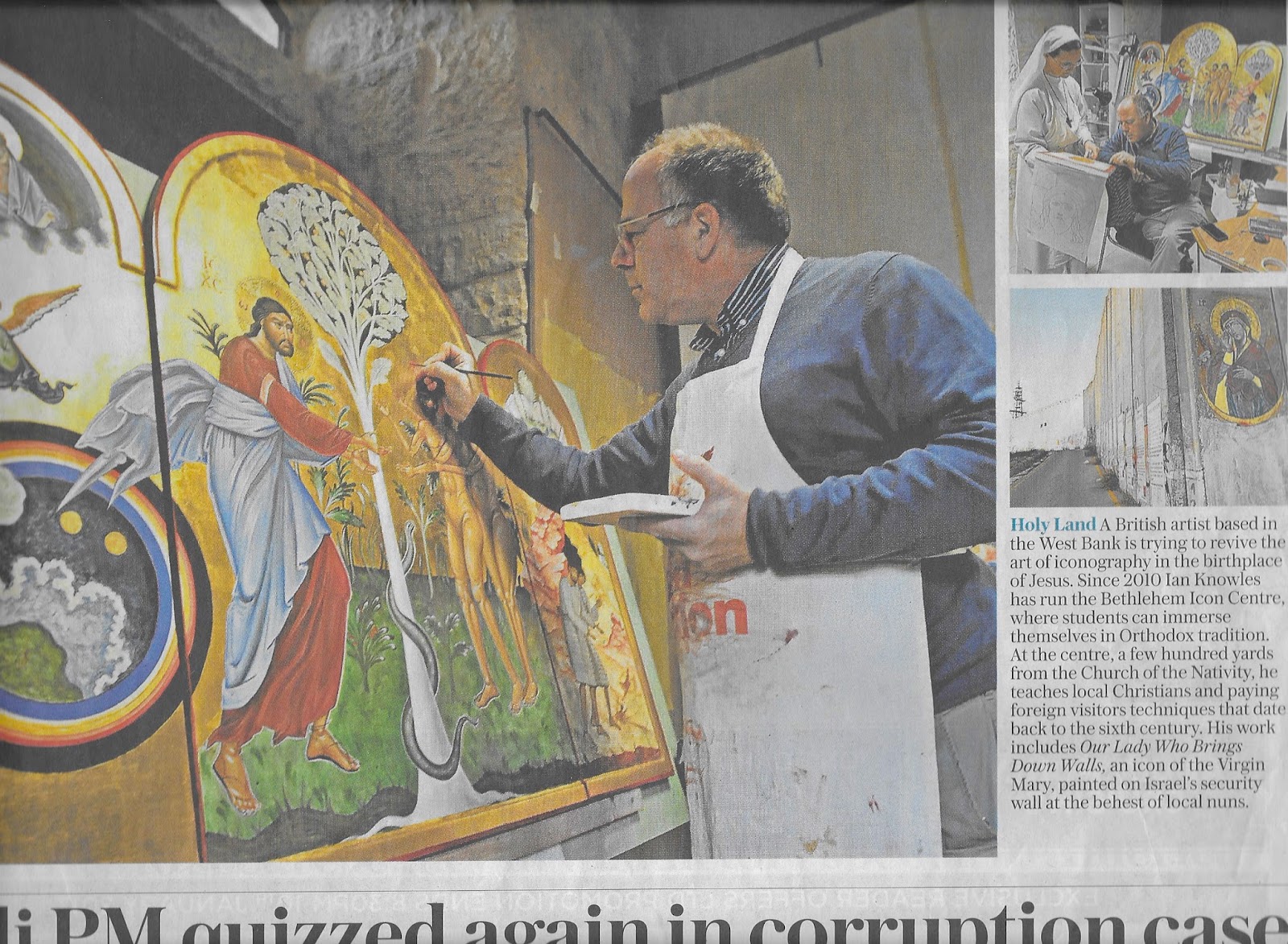
Ian Knowles in the Sunday Telegraph

Good start to 2017! As we celebrated the feast of the Epiphany, it was wonderful to see a big half page spread in the Sunday Telegraph newspaper today reporting on the Bethlehem Icon School.

We all hope and pray that the Icon school in Bethlehem continues to thrive.  (Click on the picture to enlarge.)

Read on line Here 

Tuesday, 20 December 2016

Advent and the Sacred Heart

I return to the blog after a few months absence after realising yet another dimension of reflecting and reading and icon of the Sacred Heart.  This advent the icon has drawn me into reflecting  on the great 'O' Antiphons that are said/sung in the last seven days of Advent .These are the antiphons
chanted or recited before and after the Magnificat of Vespers.  Their name comes from the fact that they all begin with "O".  The antiphons focus on the names or titles of Jesus:
words:  Sapientia, Adonai, Radix, Clavis, Oriens, Rex, and Emmanuel.

In the middle ages it was discovered that, if you adjusted the order of the names you get  ERO CRAS (I will be, tomorrow).

My advent reading of the icon this year have been aided by a fortuitous recommendation from a friend of a book by Oliver Treanor, Seven Bells to Bethlehem: The O Antiphons, Greenwing 1995.

Treanor begins the journey by focusing on the Blessed Virgin and the Magnificat. One point that I found instructive was the notion that the 'O' antiphons said/sung  before and after the Magnificat remind of her fullness as pregnant with the Son of God. This prompted me to reflect upon the many icons that as us to contemplate the image of pregnant - full of grace - Mary.  Many of these icons make use of very explicit O to remind us of the wonder of the incarnation, and the holiness of Mary.

We use the 'O' a good deal in a variety of contexts, and familiarity does breed contempt.  The antiphons, however, ask us to think far more deeply about 'O'.  And, as Treanor suggests images of a pregnant Mary help us in beginning the last stages of our advent journey.  Advent is in many ways a journey into this 'O'.  The Madonna of the 'O' expresses how Mary is full of God's grace, because she is not full of herself.  In her humility she magnifies God, and not herself.  So as we approach Christmas we have 'O'pen our hearts and minds and let the Christ child in.  When we say or sing 'O' we must try to become like Mary, and create that space wherin the Holy Spirit can dwell.   Each of the titles of the Messiah is an 'O' through which we must enter to make our journey.

Hence, of course, we begin with wisdom.  It also leads us to contemplate other icons, Mary as the seat of wisdom. Mary as the ark of the covenant, as the great exemplar of humility, and God bearer. Sapientia  and  humility have  been an important and recurring theme in my reading of this icon of the Sacred Heart ,  and with the great O antiphons, I find myself once again drawn into praying for humility and wisdom.

17th December.

O Sapientia, quae ex ore Altissimi prodiisti, attingens a fine usque ad
finem, fortiter suaviterque disponens omnia:  veni ad docendum nos viam
prudientiae.

  (O Wisdom that comest out of the mouth of the Most High,
that reachest from one end to another, and orderest all things mightily
and sweetly:  come to teach us the way of prudence.)


The antiphon of the 18th December also pulls me back into to reflecting on the fire  or furnace of love at the very heart of the icon.

O Adonai, et Dux domus Israel, qui Moysi in igne flammae rubi
apparuisti, et ei in Sina legem dedisti:  veni ad redimendum nos in
bracchio extento.

 (O Adonai, and Ruler of the house of Israel, Who
didst appear unto Moses in the burning bush, and gavest him the law in
Sinai, come to redeem us with an outstretched arm.)


I find that these first two antiphons inspire and lead me to contemplate an icon of Christ in terms of ' the root of Jesse and the key of David

December 19

O radix Iesse, qui stas in signum populorum, super quem continebunt
reges os suum, quem gentes deprecabuntur:  veni ad liberandum nos, iam
noli tardare.
(O Root of Jesse, which standest for an ensign of the
people, at Whom the kings shall shut their mouths, Whom the Gentiles
shall seek:  come to deliver us, do not tarry.)

December 20
O clavis David, et sceptrum domus Israel; qui aperis, et nemo claudit;
claudis, et nemo aperit:  veni, et educ vinctum de domo carceris,
sedentem in tenebris, et umbra mortis.

(O Key of David, and Sceptre of the house of Israel, that openeth and no man shutteth, and shutteth and no man openeth:  come to liberate the prisoner from the prison, and them
that sit in darkness, and in the shadow of death.)

And in the light of these 'O's , the light and fire in the glow of the icon illuminates splendor of the King of the Universe who came into this world as a baby.

December 21
O Oriens, splendor lucis aeternae, et sol iustitiae:  veni et illumina
sedentes in tenebris, et umbra mortis.

(O Dayspring, Brightness of the everlasting light, Son of justice:  come to give light to them that sit
in darkness and in the shadow of death.)

December 22
O Rex gentium, et desideratus earum, lapisque angularis, qui facis
utraque unum:  veni, et salva hominem, quem de limo formasti.

 (O King of the Gentiles, and desire thereof, Corner-stone that makest of two
one:  come to save man, whom Thou hast made out of the dust of the
earth.)

And then as we near the stable and contemplate Mary and Joseph and the Christ child, we behold the great truth: he is God with us!

December 23
O Emmanuel, Rex et legifer noster, expectatio gentium, et Salvator
earum:  veni ad salvandum nos, Domine Deus noster.

(O Emmanuel, our King and our Law-giver, Longing of the Gentiles, and salvation thereof:
come to save us, O Lord our God!)


Sunday, 4 September 2016

Saint Teresa of Calcutta

It is a wonderful day : we have a new Saint!  For those concerned to promote the devotion to the Sacred Heart, today's canonization is good news.  Saint Teresa was one of the most important promoters of the Sacred Heart in the twentieth century.  At a time when it was thought that the devotion was no longer relevant, Saint Teresa saw it as the very centre of her mission of love.

As she once said:

“By blood, I am Albanian. By citizenship, an Indian. By faith, I am a Catholic nun. As to my calling, I belong to the world. As to my heart, I belong entirely to the Heart of Jesus. '


And my prayer today is to ask Saint Teresa to pray for the church to be renewed by a great revival in the devotion to the Sacred Heart.

 Go here to explore the role of the Sacred Heart in her life and mission.

( The icon in the picture is very powerful, it would be good to find out more about it!)


Wednesday, 10 August 2016

Feast of Saint Teresa Benedicta of the Cross

A few years ago I noted on this blog the importance of the Sacred Heart to Edith Stein, St Teresa Benedicta of the Cross. See  here) Yesterday was her feast day, and it was timely reminder of the importance of this great Saint and how relevant she is to us in these violent and troubled times.

A passage of hers which strikes me as sone of the most beautiful and insightful  ever words written on the Sacred Heart came to mind yesterday , and they have remained with me:

'In the heart of Jesus, which was pierced, the kingdom of heaven and the land of earth are bound together. Here is for us the source of life. This heart is the heart of the Triune Divinity, and the center of all human hearts... It draws us to itself with secret power, it conceals us in itself in the Father's bosom and floods us with the Holy Spirit. This heart, it beats for us in a small tabernacle where it remains mysteriously hidden in that still, white host.' 

These words are to found in her poem:  I Will Remain With You. Read it here


Monday, 13 June 2016

'Feast' of St Mary Magdalene

My attention is often drawn towards the image of Mary Magdalene in the bottom  right hand corner of the icon.  It was, I think, significant that the Pope signed the decree to raise her memorial to the dignity of a liturgical feast, on the feast of the Sacred Heart (3rd June 2016).
As Vatican Radio reported:

"In a letter announcing the change, the Secretary of the Congregation for Divine Worship and the Discipline of the Sacraments, Arthur Roche, writes the decision means one “should reflect more deeply on the dignity of women, the New Evangelization, and the greatness of the mystery of Divine Mercy.” Archbishop Roche drew attention to the fact Mary Magdalene was the first witness to the Resurrection, and is the one who announced the event to the Apostles. “Saint Mary Magdalene is an example of true and authentic evangelization; she is an evangelist who announces the joyful central message of Easter,” he writes. “The Holy Father Francis took this decision precisely in the context of the Jubilee of Mercy to signify the importance of this woman who showed a great love for Christ and was much loved by Christ,” writes Archbishop Roche. He also notes Saint Magdalene was referred to as the "Apostle of the Apostles" (Apostolorum Apostola) by Thomas Aquinas, since she announced to them the Resurrection, and they, in turn, announced it to the whole world. “Therefore it is right that the liturgical celebration of this woman has the same grade of feast given to the celebration of the apostles in the General Roman Calendar, and shines a light on the special mission of this woman, who is an example and model for every woman in the Church.” ( See here)

Thursday, 9 June 2016

The icon and ' Give Us this Day'

As I was walking down my drive this morning  I met a delivery man walking up it with a parcel from Liturgical Press. ( See here )   I was delighted to find enclosed copies of the latest number of 'Give us this Day' which has a picture of Ian's  icon on the cover.  For those who do not know about this excellent publication, go here.

I pray that in some small way it may hope to renew its readers devotion to the Sacred Heart.

I also hope that readers will learn more about the Bethlehem Icon Centre and School and the wonderful work it is doing in the Holy Land. Read about it here. 


Sadly, for some strange reason, I cannot edit sections of the blog anymore.  So the contact the blog section is out of date. But readers may contact the blog through  'orasro@gmail.com'

Tuesday, 7 June 2016

Francis and the scarred heart

The Pope's reflections on the Feast of the Sacred Heart becomes clearer when we place them in the context of his words to priests the previous day: ( See here)


I think this is an important contribution to Francis's teaching on the Sacred Heart. Here are a few passages which strike me as especially relevant.  I have lost track of the number of times I have typed ' the scared heart of Jesus' rather than 'sacred'.   In this reflection Francis reminds us that the sacred heart is indeed a scarred heart.

 God keeps forgiving, even though he sees how hard it is for his grace to take root in the parched and rocky soil of our hearts.  He never stops sowing his mercy and his forgiveness.

 The Lord never tires of forgiving us; indeed, he renews the wineskins in which we receive that forgiveness.  He uses a new wineskin for the new wine of his mercy, not one that is patched or old.  That wineskin is mercy itself: his own mercy, which we experience and then show in helping others.  A heart that has known mercy is not old and patched, but new and re-created.  It is the heart for which David prayed: “A pure heart create for me, O God, put a steadfast spirit within me” (Ps 50:12). 

That heart, created anew, is a good vessel; it is no longer battered and leaky.  The liturgy echoes the heartfelt conviction of the Church in the beautiful prayer that follows the first reading of the Easter Vigil: “O God who wonderfully created the universe, then more wonderfully re-created it in the redemption”.  In this prayer, we affirm that the second creation is even more wondrous than the first.  Ours is a heart conscious of having been created anew thanks to the coalescence of its own poverty and God’s forgiveness; it is a “heart which has been shown mercy and shows mercy”.  It feels the balm of grace poured out upon its wounds and its sinfulness; it feels mercy assuaging its guilt, watering its aridity with love and rekindling its hope.  When, with the same grace, it then forgives other sinners and treats them with compassion, this mercy takes root in good soil, where water does not drain off but sinks in and gives life. 
The best practitioners of this mercy that rights wrongs are those who know that they themselves are forgiven and sent to help others.  We see this with addiction counsellors: those who have overcome their own addiction are usually those who can best understand, help and challenge others.  So too, the best confessors are usually themselves good penitents.  Almost all the great saints were great sinners or, like Saint Therese, knew that it was by sheer grace that they were not.

The real vessel of mercy, then, is the mercy which each of us received and which created in us a new heart.  This is the “new wineskin” to which Jesus referred (cf. Lk 5:37), the “healed sore”.
Here we enter more deeply into the mystery of the Son, Jesus, who is the Father’s mercy incarnate.  Here too we can find the definitive icon of the vessel of mercy in the wounds of the risen Lord.  Those wounds remind us that the traces of our sins, forgiven by God, never completely heal or disappear; they remain as scars.  Scars are sensitive; they do not hurt, yet they remind us of our old wounds.  God’s mercy is in those scars.  In the scars of the risen Christ, the marks of the wounds in his hands and feet but also in his pierced heart, we find the true meaning of sin and grace.  As we contemplate the wounded heart of the Lord, we see ourselves reflected in him.  His heart, and our own, are similar: both are wounded and risen.  But we know that his heart was pure love and was wounded because it willed to be so; our heart, on the other hand, was pure wound, which was healed because it allowed itself to be loved.


In the same reflection Francis also refers to another  dimension of the scarred heart of Jesus, the Blessed Virgin.  In particular he spoken about the Virgin of Guadalupe, whose shrined I have been privileged to visit twice.


  Ascending the stairway of the saints in our pursuit of vessels of mercy, we come at last to Our Lady.  She is the simple yet perfect vessel that both receives and bestows mercy.  Her free “yes” to grace is the very opposite of the sin that led to the downfall of the prodigal son.  Her mercy is very much her own, very much our own and very much that of the Church.  As she says in the Magnificat, she knows that God has looked with favour upon her humility and she recognizes that his mercy is from generation to generation.  Mary can see the working of this mercy and she feels “embraced”, together with all of Israel, by it.  She treasures in her heart the memory and promise of God’s infinite mercy for his people.  Hers is the Magnificat of a pure and overflowing heart that sees all of history and each individual person with a mother’s mercy.
            During the moments I was able to spend alone with Mary during my visit to Mexico, as I gazed at Our Lady, the Virgin of Guadalupe and I let her gaze at me, I prayed for you, dear priests, to be good pastors of souls.  In my address to the bishops, I mentioned that I have often reflected on the mystery of Mary’s gaze, its tenderness and its sweetness that give us the courage to open our hearts to God’s mercy.  I would now like to reflect with you on a few of the ways that Our Lady “gazes” especially at priests, since through us she wants to gaze at her people.
            Mary’s gaze makes us feel her maternal embrace.  She shows us that “the only power capable of winning human hearts is the tenderness of God.  What delights and attracts, humbles and overcomes, opens and unleashes is not the power of instruments or the force of the law, but rather the omnipotent weakness of divine love, which is the irresistible force of its gentleness and the irrevocable pledge of its mercy” (Address to the Mexican Bishops, 13 February 2016).  What people seek in the eyes of Mary is “a place of rest where people, still orphans and disinherited, may find a place of refuge, a home.”  And that has to do with the way she “gazes” – her eyes open up a space that is inviting, not at all like a tribunal or an office.  If at times people realize that their own gaze has become hardened, that they tend to look at people with annoyance or coldness, they can turn back to her in heartfelt humility.  For Our Lady can remove every “cataract” that prevents them from seeing Christ in people’s souls.  She can remove the myopia that fails to see the needs of others, which are the needs of the incarnate Lord, as well as the hyperopia that cannot see the details, “the small print”, where the truly important things are played out in the life of the Church and of the family.
            Another aspect of Mary’s gaze to do with weaving.  Mary gazes “by weaving”, by finding a way to bring good out of all the things that her people lay at her feet.  I told the Mexican bishops that, “in the mantle of the Mexican soul, with the thread of its mestizo features, God has woven in la Morenita the face by which he wishes to be known”.  A spiritual master teaches us that “whatever is said of Mary specially is said of the Church universally and of each soul individually” (cf. Isaac of Stella, Serm. 51: PL 194, 1863).  If we consider how God wove the face and figure of Our Lady of Guadalupe into Juan Diego’s cloak, we can prayerfully ponder how he is weaving our soul and the life of the whole Church. 
They say that it is impossible to see how the image of Our Lady of Guadalupe was “painted”; it seems to have been somehow “imprinted”.  I like to think that the miracle was not only that the image was imprinted or painted, but that the entire cloak was re-created, transformed from top to bottom.  Each thread – those threads of maguey leaf that women had learned from childhood to weave for their finest garments – was transfigured in its place, and, interwoven with all the others, revealed the face of our Lady, her presence and her surroundings.  God’s mercy does the same thing.  It doesn’t “paint” us a pretty face, or airbrush the reality of who we are.  Rather, with the very threads of our poverty and sinfulness, interwoven with the Father’s love, it so weaves us that our soul is renewed and recovers its true image, the image of Jesus.  So be priests “capable of imitating this freedom of God, who chooses the humble in order to reveal the majesty of his countenance, priests capable of imitating God’s patience by weaving the new humanity which your country awaits with the fine thread of all those whom you encounter.  Don’t give into the temptation to go elsewhere, as if the love of God were not powerful enough to bring about change” (Address to the Mexican Bishops, 13 February 2016).
       
These thoughts of the Pope provide much food for thought in this month when we have a special care to remember the scarred and sacred heart of Jesus, and the pure and open heart of his blessed mother.


Friday, 3 June 2016

Feast of the Sacred Heart of Jesus

After a long absence, today draws me back to reflect on the icon and  Saint Mary's Catholic Church in Bridgend, South Wales. First built in the middle of the 19th Century, the present building was completed in 1998.    It was an appropriate church to celebrate the feast as the design of the building was inspired by the symbolism of the Pelican - a truly ancient Christian symbol of Christ.   The guide to the Church tells us that the 'interior shape  and design of the building , especially its support beams, convey  the sense of being within the heart of Christ'.  The Tabernacle  has splendid Pelican on the top and is engraved  with an image of the Pelican feeding its young.  Outside the church visitors are greeted by a large statue of the Sacred Heart, and there is, of course, one inside.  The symbol of the Pelican  has long since fallen out of popular favour - not least because we know that the Pelican does not feed its chicks with its own blood  when no other food could be had.  But for centuries the symbol of the Pelican as a a symbol of self-sacrificing love was widespread.  St Thomas, of course in   Adoro te devote says, for example:

Pie Pelicane, Jesu Domine,
Me immundum munda tuo sanguine:
Cujus una stilla salvum facere
Totum mundum quit ab omni scelere.

And as I sat in this lovely church I reflected on the profound truths which this ancient symbol expresses and marvelled at the wisdom of the parish in commissioning such a design in the 1990s!  However, I was less clear about the relationship between the readings  at mass and the Sacred Heart.  However, it all became clearer when I read the text of Pope Francis's homily today.  Read here.  So during the day the Pelican and Francis's words have made me think about the meaning of the feast!  I'm still thinking.


The Pelican image is clearly one which has great affinity to that of the Sacred Heart, and the Blessed Sacrament.  This is apparent in so much imagery which links the Sacred Heart, the eucharist and the Pelican, and the church in Bridgend does this on an architectural scale, as a simple holy picture does it in a small and intimate way.  Perhaps we have lost this 'pelican' sense of the Sacred Heart as a symbol of God's totally self-sacrificing love.  To enter St Mary's is to be reminded of it in a wonderful way.  So, it was a perfect place to celebrate the feast.    But, the readings at mass did not seem to connect with this, but having read Pope Francis's homily,  the connections started to happen.

As we have noted elsewhere on this blog, since becoming Pope Francis has progressively unfolded his teaching on the Sacred Heart. His remarks at mass were directed at priests, but they clearly have an application to all the faithful.  In the homily he had this to say in just a few extracts:

..the Solemnity of the Sacred Heart of Jesus invites us all to turn to the heart, the deepest root and foundation of every person, the focus of our affective life and, in a word, his or her very core....
The Heart of the Good Shepherd is not only the Heart that shows us mercy, but is itself mercy. There the Father’s love shines forth; there I know I am welcomed and understood as I am; there, with all my sins and limitations, I know the certainty that I am chosen and loved. Contemplating that heart, .. The Heart of the Good Shepherd tells us that his love is limitless; it is never exhausted and it never gives up. There we see his infinite and boundless self-giving; there we find the source of that faithful and meek love which sets free and makes others free; there we constantly discover anew that Jesus loves us “even to the end” (Jn 13:1), without ever being imposing....Contemplating the Heart of Christ, we are faced with the fundamental question of our priestly life: Where is my heart directed? Our ministry is often full of plans, projects and activities: from catechesis to liturgy, to works of charity, to pastoral and administrative commitments. Amid all these, we must still ask ourselves: What is my heart set on, where is it directed, what is the treasure that it seeks? For as Jesus says: “Where your treasure is, there will your heart be also” (Mt 6:21).

Turning to the readings at mass, the Pope taught that:

            To help our hearts burn with the charity of Jesus the Good Shepherd, we can train ourselves to do three things suggested to us by today’s readings: seek out, include and rejoice.
            Seek out. The prophet Ezekiel reminds us that God himself goes out in search of his sheep (Ez 34:11, 16). As the Gospel says, he “goes out in search of the one who is lost” (Lk 15:4), without fear of the risks. Without delaying, he leaves the pasture and his regular workday. He does not put off the search. He does not think: “I have done enough for today; I’ll worry about it tomorrow”. Instead, he immediately sets to it; his heart is anxious until he finds that one lost sheep. Having found it, he forgets his weariness and puts the sheep on his shoulders, fully content.
            Such is a heart that seeks out – a heart that does not set aside times and spaces as private, a heart that is not jealous of its legitimate quiet time and never demands that it be left alone. A shepherd after the heart of God does not protect his own comfort zone; he is not worried about protecting his good name, but rather, without fearing criticism, he is disposed to take risks in seeking to imitate his Lord.
            A shepherd after the heart of God has a heart sufficiently free to set aside his own concerns. He does not live by calculating his gains or how long he has worked: he is not an accountant of the Spirit, but a Good Samaritan who seeks out those in need. .... Like every good Christian, and as an example for every Christian, he constantly goes out of himself. The epicentre of his heart is outside of himself. He is not drawn by his own “I”, but by the “Thou” of God and by the “we” of other men and women.
            Include. Christ loves and knows his sheep. He gives his life for them, and no one is a stranger to him (cf. Jn 10:11-14).  His flock is his family and his life. He is not a boss to feared by his flock, but a shepherd who walks alongside them and calls them by name (cf. Jn 10:3-4). He wants to gather the sheep that are not yet of his fold (cf. Jn 10:16).
            So it is also with the priest of Christ. He is anointed for his people, not to choose his own projects but to be close to the real men and women whom God has entrusted to him. No one is excluded from his heart, his prayers or his smile. With a father’s loving gaze and heart, he welcomes and includes everyone, and if at times he has to correct, it is to draw people closer. He stands apart from no one, but is always ready to dirty his hands. As a minister of the communion that he celebrates and lives, he does not await greetings and compliments from others, but is the first to reach out, rejecting gossip, judgements and malice. He listens patiently to the problems of his people and accompanies them, sowing God’s forgiveness with generous compassion. He does not scold those who wander off or lose their way, but is always ready to bring them back and to resolve difficulties and disagreements.
            Rejoice. God is “full of joy” (cf. Lk 15:5). His joy is born of forgiveness, of life risen and renewed, of prodigal children who breathe once more the sweet air of home. The joy of Jesus the Good Shepherd is not a joy for himself alone, but a joy for others and with others, the true joy of love. This is also the joy of the priest. He is changed by the mercy that he freely gives. In prayer he discovers God’s consolation and realizes that nothing is more powerful than his love. He thus experiences inner peace, and is happy to be a channel of mercy, to bring men and women closer to the Heart of God. Sadness for him is not the norm, but only a step along the way; harshness is foreign to him, because he is a shepherd after the meek Heart of God.
            Dear priests, in the Eucharistic celebration we rediscover each day our identity as shepherds. In every Mass, may we truly make our own the words of Christ: “This is my body, which is given up for you.”  This is the meaning of our life; with these words, in a real way we can daily renew the promises we made at our priestly ordination. I thank all of you for saying “yes” to giving your life in union with Jesus: for in this is found the pure source of our joy.

For me a few lines stand out and helped me to reflect on the feast of the Sacred Heart and the icon:  the first is that the Sacred Heart is a symbol of  "The epicentre of [our] heart [has to be ] outside of [ourselves]. We must be  drawn by not by our  selves , but by 'the “Thou” of God and by the “we” of other men and women.' The second is that we ought to focus more on the line 'This is my body given up for you.'  St Thomas refers to Christ as a Pelican, and it is this image which powerfully expresses the idea that to share the body and blood of Christ is to give up our hearts to God and to other people.

Tuesday, 26 January 2016

Heart hearts and hard times

The world is in one hell of a mess!  It is a real challenge to read a newspaper or watch TV or radio news without falling into a pit of despair.  The other day Pope Francis said something which made me think about the reasons behind the dire state of the world. It was in his homily on the story of Saul and David (see here) The Pope
prayed:


May the Lord grant us the grace of an open heart, of a heart open to the voice of the Spirit, which knows how to discern what should not change, because it is fundamental, from what should change in order to be able to receive the newness of the Spirit.


Hard hearts  or cold hearts or hearts  of stone are one of the the main concerns of the devotion to the Sacred Heart. Modern men and  women have closed their hearts to God. Without hearts open to the love of God and lives open to the Holy Spirit there is little hope for humanity.

Pope Francis's words prompted me to think of stone and why scripture refers to hearts of stone.  And this in turn prompted me to think ( of all things) about those lines in the film the Godfather III. As I live near the coast I spend a fair amount of time looking into pebble filled pools, and the words of Cardinal Lamberto  sometimes comes to mind -  when he picks up a stone from a fountain and  says :
' Look at this stone. It has been lying in the water for a very long time, but the water has not penetrated it.” He gives the stone a sharp blow and splits it in two.  Showing it to  Don Michael he observes, “Look. Perfectly dry. The same thing has happened to men in Europe. For centuries they have been surrounded by Christianity, but Christ has not penetrated. Christ doesn’t breathe within them.” View here.


And that is the sadness of it all.  Like the stones in water, human beings in the West have been surrounded by the living waters of Christ, but they have not been penetrated by it.  Their hearts are dry, hard and closed.  Is it any wonder that the world is in such a mess? The devotion to the Sacred Heart is more important to the future of humanity than we can really understand. The only hope for our planet is that we can open our hearts and allow God's spirit to penetrate us and breathe fire into us.


Sunday, 3 January 2016

The adoration of the Magi

In terms of pondering the Christmas story in our hearts, the adoration of the magi has long fascinated me. I think one of my favourite images is Giotto's depiction.  It is just the sheer simplicity.  All eyes are on Jesus, apart from a wayward camel and a young man who is having a job keeping the camels under control.  When I think about the scene I am prompted to remember the last time we read about the childhood of Jesus - when he is lost and then found in the temple.  Both the adoration of the magi and the finding of Jesus are about how we make assumptions and suppositions.  Mary and Joseph assume that Jesus is with each other, and assume that he is still a child, when he is actually about his father's business.  The wise men assume that the star is leading them to the scene of a great event in a palace: the birth of a King.  They get some of it right, and clearly they have done all the calculations and have followed the star.   Just as Mary says to the Angel Gabriel at the Annunciation 'how can this be?', so the wise men must also have been thinking as they approached the stable 'how can this be?' This is not what they expected.  They assumed it would be rather more than a humble little shack. The boy trying to calm the camels down seems to be saying: 'I have no idea what is going on here, either.'  Jesus will spend the rest of his life on earth challenging assumptions and human reasoning.   The wise men must, on the one hand, have felt immensely clever.  They travelled all that way on the basis of some complex astronomical calculation -  but on the other hand, what was supposed to be there under the star was  just not there. They were expecting majesty and they got humility.   Reason got them there alright, but in Giotto's picture we see the moment when they realise that reason and worldly wisdom  was not going to take them any further.  Reason has its limits: all they could now do was open their hearts and adore.  Mary had done the same 9 months earlier.  She could not understand how it could be so, but was prepared to open her heart to the Holy Spirt.


As for me, I think I am more  like the camel boy than the wise men : I find it difficult to respond to the way in which God challenges my assumptions and expectations. Like the boy and the camels I am not wise enough to abandon my assumptions and open my eyes and heart and just simply adore. This year I will try to be less like my alter ego,  the camel boy!