Thursday, 21 March 2013

Pope Francis, God's bricklayer.


As I heard the name of Francis announced last Wednesday night I felt, like many Catholics, I am sure, elated and deeply moved by the choice of the name of one of our most beloved saints, St. Francis of Assisi. The image that came into my mind was the famous picture by Giotto of St. Francis being told by Christ in the church of San Damiano to ‘repair my Church because it is falling into ruin’. Francis (the first) has, like his namesake, now taken on the job of ‘God’s bricklayer’.

At a time when the church is indeed in a poor state of repair, the new Pope has accepted the mission to repair and rebuild.  On the face of it a 76 -year-old man with one decent lung is hardly the kind of person that you would think would have the strength to undertake the task of tackling the mess that has proven too much for his predecessors.  Significantly, to do this he has wisely chosen to show that reforming the Catholic Church can only be done by harnessing one of the most empowering of all virtues (and the one that St. Francis exemplified): humility.

Like St. Francis, the new Pope has a reputation for humility and a love of the poor.  But St. Francis also realized that he could not repair San Damiano on his own.  Pope Francis will also need a good team of co-workers to stop the Church of the 21st century from falling into ruin. It may be, however, that because Pope Francis is an outside contractor from Latin America rather than a European bricklayer he will better able to get on with a job that was manifestly beyond the capacity of more local builders.  Without assembling a team of men and women (St. Francis had St. Clare!) with the necessary skills who share his commitment to repairing the Church, he is unlikely to get very far.  So the next few months will be a critical phase of his project management: recruiting a team of co-workers who are eager to get on with the job of laying new bricks and repairing the damage.

The choice of the name Francis sends the strongest possible message to the world that the repair and rebuilding which is so very necessary can only be accomplished through the exercise of humility: repairing the church can only come about by understanding the poverty of the Church and by placing the poverty of so much of the world at the very centre of the re-building process.  A Pope named Francis must embrace poverty of spirit as well as the poor of the world.  As he made it clear in his first press conference, he chose the name because St. Francis was:

‘..the man of the poor. The man of peace. The man who loved and cared for creation and in this moment we don't have such a great relationship with the creator. The man who gives us this spirit of peace, the poor man who wanted a poor church.’

A poor church must recognize that the election of Jorge Mario Bergoglio demonstrates in a most dramatic fashion that Europe is no longer the centre of the Catholic world.  The Catholic Church in Europe must also learn humility and understand its own poverty and deficiencies.

The simple name ‘Francis’ is rich in meaning to Catholics all over the world.  It is a truly revolutionary name as it evokes not only St Francis’s humility and concern for the poor and social justice, but also, as the Pope noted at his first ‘press conference’, St. Francis’s love of nature and creation.  It is not just the Catholic church that is in need of repair: so is what Francis called (in the ‘Canticle of the Sun’) our ‘ sister, mother earth’.  The concern for social justice and human greed and materialism we find in St Francis is inextricably connected with environmental justice and the importance of respect for all creation.

There is another aspect of  ‘il Poverello d'Assisi’ that may serve as a guide to how the new Pope may conduct his pontificate: peace.   St. Francis, in his humility, was a man of peace: he is famously associated with a prayer about becoming a channel or instrument of peace.  In 1219, for example, whilst the Crusaders were laying siege to the camp of Sultan Malek – Kemal, St. Francis made the brave gesture of going to see the Sultan and explain the Christian faith to him. So, it may be that God’s new bricklayer will also see building a new relationship with Islam and breaking down some of the walls that keep faith communities and traditions apart as a central aspect of his pontificate. Bricklayers  - especially the great bridge-builder (‘Pontifex Maximus’) – must also build and repair bridges and not just Churches.

If all of this sounds a very big contract for a 76 -year -old Argentine bricklayer, we should reflect that a previous Pope, John XXIII (1958-1963), was 77 when he took the job on! And John set out an agenda that has had the most wide-ranging impact on the Church.  (He was expected to be more of a ‘caretaker’ than a bricklayer. ) Pope Francis, by virtue of a name that is so closely associated with humility, poverty, social justice, the natural world and peace, may well be able to lay a more level, firmer and stronger foundation for a Church poor in spirit in the 21st century than a Pope by any other name.  Few Popes in history have begun their pontificate with such high expectations, and few have had a name that is so universally loved and which evokes such a powerful critique of the materialism of modern society.  All this means that the new Pope has provided a clear criteria or bench mark by which we may judge his papacy: ‘how true is his work to the spirit level of ‘il Poverello d'Assisi’?’  That is quite a name to have chosen!

Thursday, 14 March 2013

Pope Francis and the the Sacred Heart

The news of the election of a new Holy Father has generated a real sense of hope and anticipation that the Church can now move ahead.  It is clear that Francis intended that the way ahead must be walked humbly with our God.  This theme of humility, which seems to have come ever more to the surface in reading this icon, is evidently to be the central theme of the new Papacy, and we have to thank God for this.  Now, more than ever the Church must seek to become humble of heart in the face of the sins committed in the Catholic Church at all levels.  Will Francis be a Pope of the Sacred Heart- like his predecessors, John Paul II and Benedict XVI?  My guess is that he will be a Pope who will direct our attention to the importance of the devotion for the renewal of the Church.  As a Jesuit he will, of course, have a special love of the Sacred Heart.  But he has also chosen the name of Francis - and St Francis of Assisi and the Franciscan spiritual tradition has also played a very important role in the history of the devotion. Indeed, there can be little doubt that the Jesuits and the Franciscans have done more than most religious orders to promote the devotion.  So, a Jesuit pope, with the name of Francis must surely be someone with a great love of the Sacred Heart.  I have yet to get to grips with what Francis has had to say about the Sacred Heart, but it will be interesting to find out.  So, the Seraphim in the top left hand corner has yet another layer of meaning now!

Friday, 8 March 2013

Manning : a Cardinal for troubling times.


So much in the news of late about the comings and goings of Cardinals, that it is fortunate I seem to have spent more and more time this Lent  reflecting on Cardinal Henry Manning and reading his book on the Glories of the Sacred Heart.  It is good to remind ourselves of the contribution which some truly great Cardinals - like Manning - have made to the life of the Church at a time when the standing of some is, to say the least, questionable.

The absolutely centrality of the relationship between the Sacred Heart and the social teaching of the Church  may grasped in Manning's observations on the life of St. Vincent de Paul ( made in 1861).

Look at the condition of the classes of England; the  separation of the rich from the poor ; at the unequal  distribution of wealth ; at the unwieldy miseries and  irremediable distresses of our millions. Private charity -  is exhausted ; public relief breaks down ; and pauperism  and hunger gain head against all we do. We were told  the other day, that every week one person at least dies  of actual starvation in London. Whether that be so or  not, I cannot tell ; it is a statement put forward by those  who ought to know. With all our wealth and skill and  pride of government, the political powers of the world  are incapable of redressing evils such as these, which are  the degradations of barbarism, not the maladies of  Christian society. There is only one power that can  redress these social evils, that is, the supernatural power of charity. There is nothing for us but the revolution  of charity — the action of God: — the return of God and His kingdom into this land, that can preserve us from  the scourge which threatens us now.  And who can accomplish this revolution of charity ? …What power  can do so ? Only that one so long despised. Charity  is no abstraction. It has its presence and its form on earth. It was first organised in the Catholic Church on  the day of Pentecost, and has wrought throughout the  world from that day to this. It has borne its fruits-  in a thousand Saints like Vincent of Paul, and contains  in itself the ever-fresh and inexhaustible vigour of its-  youth in every land and age. ..But just as France was organised by the charity and zeal of Vincent and his companions, who spread all over France a network, as it were, of charities, so the one  only power which can ever reunite the classes of England  in bonds of mutual submission and benevolence, is the  universal action of the same supernatural charity which springs from the Sacred Heart of Jesus, and is applied  by the equal operation and the divine unity of the Church of God. (Ecclesiastical Sermons, Vol. I., p. 89, my emphasis)
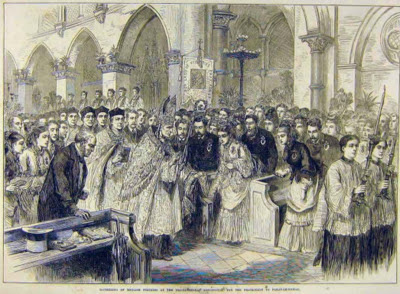
Manning at the ceremony in Kensington prior to the departure to France.
Twelve year later, in 1873, Manning was to lead a memorable pilgrimage to the shrine at Paray-le Monial.  And subsequently ( in 1876) , as a response to the critical reception to the pilgrimage, he was to publish a book – The Glories of the Sacred Heart - which set out to tackle the objections of those (especially from the Anglican Church) who expressed antipathy towards the devotion.

It is very apparent when we read his thoughts on  the social questions of his day that Manning believed that the Sacred Heart was the very source of the love which he saw as the only way in which a true ‘revolution’ that could redress ‘social evil’ could come about.  The social teaching of the Catholic Church as it was to develop from Rerum Novarum onwards springs – from his perspective - from the Sacred Heart of Jesus.  His  commitment to social improvement and social justice and his passionate love of the Sacred Heart were one and the same burning flame that illuminated and informed his life and work as a whole.  Indeed, it is only when human beings harness the love of God which radiates from the heart of the Saviour can we really revolutionise and turn the world upside down. For Manning, the Sacred Heart was a private devotion which powered our efforts to apply the Gospel to political, economic and social problems.  Hence, the much publicised pilgrimage to the Paray-le Monial in 1873  was both a profoundly personal journey, but also an essentially public demonstration of faith.  Manning was bringing the Sacred Heart into the centre of the public square, just as he was bringing Catholic teaching into political economy of his day.

Manning himself had made a study of political economy as a young man – prior to his decision to become a priest.  He certainly knew the literature, as well as several leading political economists.  He was a friend of John Ruskin and was  evidently influenced  by his essays on political economy - such as Unto this Last.   Manning believed that (in a sense) the heart or the religious/moral/ ethical dimensions had been removed from the subject.  Political economy had ( as Ruskin argued) wholly distorted the role of human selfishness and was narrowly focused on physical capital, money wealth,  profit and loss and largely neglected the understanding and appreciation of the social economy, and sacredness of human relationships and human dignity.  Thus pre-occupied, political economy was concerned with seeing to the lower level of human instincts rather than address the way in which 'the economy' involved a moral dimension.

For Manning  political economy had become heartless and inhuman by the way it had removed considerations of ethics and by its over-preoccupation with  self-interested human behaviour.  From being about the home: the health, morals and welfare of families, ‘economics’ had become driven purely by considerations of the operations of profit and loss.  For Manning consideration had to be given to the way in which capitalism gives rise to public misery and evils. For him, the alternative was not letting the free market just rip or abolishing capitalism: the alternative was a moral order which can be found in the Christian gospel. Thus the solution to the social evils of poverty, low wages, ill-health, inadequate housing and the rest, ultimately sprung from the Sacred Heart.

What Manning is saying is that  a real revolution in society involves a revolution in the minds and hearts of individuals.  A Christian revolution begins in the heart and then expresses itself in social action.  We have to love God with our whole heart first, and then we will love our neighbour as ourself.  Without receiving Christ in our heart, we cannot change the world. Devotion to the Sacred Heart was, therefore, a necessary pre-condtion for the theory and practice of the social, economic and political dimensions of Christian life. Hence, this great advocate of Catholic social teaching, was also a great advocate of devotion to the Sacred Heart.  St Vincent is his model for this relationship between the glowing flame of love represented in the Sacred Heart, and the practice of charity in the world. We cannot hope to assist in giving birth to a new society if Christ has not first been born in our hearts. We cannot set the world aflame if our hearts are cold.


A civilisation  of love could not be built in conditions in which a small proportion of society exercised power and domination over the vast majority.  It could not be built in a society that was unjust and failed to recognise the dignity and worth of all human beings.  A society informed by the gospel of Jesus Christ must necessarily involve acknowledging the rights of workers and the right to be treated with the same dignity as those with power and wealth would want to be treated.  The rights of the great  wealthy families and of Capital should not exceed and exclude those of the families of the  poor and Labour.  The weak should not be left at the mercy of the strong: government must strive to ensure, through law and legislation,  that human dignity and liberty is for the many not the few. Economics was about human dignity, an a sense of the common good not just wealth measured by money.

For Manning the gospel message of loving our neighbours as ourselves had to be preached in the very heart of  public life.  And thus his social teaching and his promotion of devotion to the Sacred Heart were essentially two dimensions of the same  mission to proclaim the gospel in an age which was becoming increasingly materialistic, utilitarian and indifferent and hostile to Christianity.  In this he has much in common with Leo XIII. Despite the significance of Rerum Novarum, Leo maintained that it was his decision to dedicate the whole world to the Sacred Heart  which was the most important act of his whole pontificate.  Annum Sacrum (1899) makes the linkage between social teaching and the Sacred Heart quite explicit.


10. Such an act of consecration, since it can establish or draw tighter the bonds which naturally connect public affairs with God, gives to States a hope of better things. In these latter times especially, a policy has been followed which has resulted in a sort of wall being raised between the Church and civil society. In the constitution and administration of States the authority of sacred and divine law is utterly disregarded, with a view to the exclusion of religion from having any constant part in public life. This policy almost tends to the removal of the Christian faith from our midst, and, if that were possible, of the banishment of God Himself from the earth. When men's minds are raised to such a height of insolent pride, what wonder is it that the greater part of the human race should have fallen into such disquiet of mind and be buffeted by waves so rough that no one is suffered to be free from anxiety and peril? When religion is once discarded it follows of necessity that the surest foundations of the public welfare must give way, whilst God, to inflict on His enemies the punishment they so richly deserve, has left them the prey of their own evil desires, so that they give themselves up to their passions and finally wear themselves out by excess of liberty.


By the time of Annum Sacrum Manning himself had died (in 1892).  But it seems to me that, as with case of the ideas which informed Rerum Novarum, the approach of Annum Sacrum was anticipated by Manning.   It is evident that Manning had made the link between social justice and the Sacred Heart back in the 1860s - as his observations on St. Vincent show.  He also was keen to put the Sacred Heart very much into the public square: hence his robust defence of the pilgrimage of 1873.  Leo's dedication of the whole world to the Sacred Heart in relation to the place of the Gospel in public life in many ways is anticipated by Manning.  He wanted to see the Sacred Heart as THE symbol of Christianity in a materialistic and secular world.   This idea is set out quite explicitly in Annum Sacrum in a way that Manning would have endorsed.  Leo argues : 

12. When the Church, in the days immediately succeeding her institution, was oppressed beneath the yoke of the Caesars, a young Emperor saw in the heavens a cross, which became at once the happy omen and cause of the glorious victory that soon followed. And now, to-day, behold another blessed and heavenly token is offered to our sight-the most Sacred Heart of Jesus, with a cross rising from it and shining forth with dazzling splendor amidst flames of love. In that Sacred Heart all our hopes should be placed, and from it the salvation of men is to be confidently besought.


The Sacred Heart, therefore, as the symbol of Christianity in the modern age.  It is in this heart that 'all our hopes should be placed, and from it the salvation of men is to be confidently besought.'  As the Church faces up to a difficult and challenging period in its long history, we should keep Leo's hopes at the forefront of our thoughts and prayers.


Friday, 1 March 2013

St David's Day

St Non's well. 
With the thoughts of Benedict's last tweet  still very much in my mind St. David's day  takes on a  new immediacy and relevance for the 21st century.  It seems to me that a saint is a human being who is - through the Grace of God- able to put Christ at the very centre of their whole life.  When Benedict asks us to put Christ at the centre of our lives he is asking us to learn from the saints who did exactly that.   And when that happens human beings can experience true joy.  This reminded me of St David's last words which urged  his followers to be joyful in their faith.  Related to this is a key symbol in the life of David, and in the devotion to the Heart of Christ: water.  Benedict in his letter to  Peter-Hans Kolvenbach, S.J. in 2006 , observes that ' the gifts received from the open side, from which "blood and water" flowed (cf. Jn 19: 34), ensure that our lives will also become for others a source from which "rivers of living water" flow (Jn 7: 38; cf. Deus Caritas Est, n. 7)' .  In this, as in other respects, the devotion to the Sacred Heart is, as he argues, as 'old as Christianity itself'.   Legend has it that when David was born (circa 598-601 AD)  a stream of water came gushing out of the ground.  The resulting well - St Non's well - has been a place of pilgrimage for many centuries- and when I was there last there was group of people from Brittany who blessed themselves with the water and left  flowers by the well and in St Non's Chapel.

St Non's Chapel
I have some  water drawn from the well last summer and I was able to bless myself with it today. Deo Gratias.  All over Wales there are holy wells which are associated with saints. It is not too difficult to understand why.  Given that a saint has Christ alive and flaming in their hearts, it is not so surprising that people associated someone who was full of the Holy Spirit with flowing water.  They were channels of  the love of God and the fullness of God's love literally bursts out of the earth as a symbol of the living water that flowed from the heart of Christ.  My ancestors who revered these wells did so because they saw all things in Christ. Water, a powerful symbol of the Holy Spirit, was therefore a central aspect of their Christian spirituality.  Sadly, with the Reformation, the people of Wales were to lose contact with this important aspect of their Catholic inheritance. We can only hope and pray that the joyful faith of David the 'waterman' will continue to flow into the life of the nation.

Thursday, 28 February 2013

Benedict's departure: Making reparation for the sins of the Church


On this historic day when  Benedict XVI concludes his Pontificate  I think it is appropriate to recall that,   like many his predecessors, Benedict has been a Pope of the Sacred Heart.   We can only hope and pray that the Sacred Heart will be close to the heart of the next Pope.   In the light of the problems that have to be addressed by the new Pope, we should remember that a central aspect of the devotion is to seek to make reparation for our sins.  There are many who have made the Lord weep:  the Church, led by the new Pope, must make reparation for the grave sins committed by some of our leaders.  And this is what this crisis is about. It is a crisis of leadership, rather than one of faith.  Please God, that we will have a Pope with the strength and energy to give the Church the leadership the faithful so desire.  In all of this, we ask Sacred Heart to have mercy on us.  The Heart of the Saviour has been pierced and wounded by those who were charged with feeding his sheep.

So we can recall some of the words of Benedict on those most important devotion of the Church.

After the tearing of the Temple curtain and the opening of the heart of God in the pierced heart of the Crucified, do we still need sacred space, sacred time, mediating symbols? Yes, we do need them, precisely so that, through the 'image', through the sign, we learn to see the openness of heaven. We need them to give us the capacity to know the mystery of God in the pierced heart of the Crucified.
Joseph Cardinal Ratzinger, The Spirit of the Liturgy, 2000, p61

In the Heart of Jesus, the center of Christianity is set before us. It expresses everything, all that is genuinely new and revolutionary in the New Covenant. This Heart calls to our heart. It invites us to step forth out of the futile attempt of self-preservation and, by joining in the task of love, by handing ourselves over to him and with him, to discover the fullness of love which alone is eternity and which alone sustains the world. Joseph Cardinal Ratzinger, (Behold the Pierced One, 1981)


In the pierced heart of the Crucified, God's own heart is opened up; here we see who God is and what he is like. Heaven is no longer locked up. God has stepped out of his hiddenness. That is why St John sums up both the meaning of the Cross and the nature of the new worship of God in the mysterious promise made through the prophet Zechariah (cf. 12:10). 'They shall look on him whom they have pierced' (Jn 19.37). Joseph Cardinal Ratizinger, The Spirit of the Liturgy, 2000, p48


From : ADDRESS TO PILGRIMS FROM THE DIOCESE OF VERONA ITALY Saturday, 4 June 2005

the Solemnity of the Sacred Heart of Jesus: only in this inexhaustible source of love will you be able to find the necessary energy for your mission.
The Church was born from the Heart of the Redeemer, from his pierced side, and she is ceaselessly renewed in the sacraments.
May it be your concern to draw spiritual nourishment from prayer and an intense sacramental life; deepen your personal knowledge of Christ and strive with all your might for the "high standard of ordinary Christian living" which is what holiness is, as our beloved John Paul II used to say.


From : LETTER OF HIS HOLINESS BENEDICT XVI
ON OCCASION OF THE 50TH ANNIVERSARY OF
THE ENCYCLICAL "HAURIETIS AQUAS, 2006'

To the Most Reverend Father Peter-Hans Kolvenbach, S.J.
Superior General of the Society of Jesus
By encouraging devotion to the Heart of Jesus, the Encyclical Haurietis Aquas exhorted believers to open themselves to the mystery of God and of his love and to allow themselves to be transformed by it. After 50 years, it is still a fitting task for Christians to continue to deepen their relationship with the Heart of Jesus, in such a way as to revive their faith in the saving love of God and to welcome him ever better into their lives.
The Redeemer's pierced side is the source to which the Encyclical Haurietis Aquas refers us:  we must draw from this source to attain true knowledge of Jesus Christ and a deeper experience of his love.
Thus, we will be able to understand better what it means to know God's love in Jesus Christ, to experience him, keeping our gaze fixed on him to the point that we live entirely on the experience of his love, so that we can subsequently witness to it to others.
Indeed, to take up a saying of my venerable Predecessor John Paul II, "In the Heart of Christ, man's heart learns to know the genuine and unique meaning of his life and of his destiny, to understand the value of an authentically Christian life, to keep himself from certain perversions of the human heart, and to unite the filial love for God and the love of neighbour".
Thus:  "The true reparation asked by the Heart of the Saviour will come when the civilization of the Heart of Christ can be built upon the ruins heaped up by hatred and violence" (Letter to Fr Peter-Hans Kolvenbach, Superior General of the Society of Jesus for the Beatification of Bl. Claude de la Colombière, 5 Moreover, not only does this mystery of God's love for us constitute the content of the worship of and devotion to the Heart of Jesus, but in the same way it is likewise the content of all true spirituality and Christian devotion. It is consequently important to stress that the basis of the devotion is as old as Christianity itself.
…

The deepest meaning of this devotion to God's love is revealed solely through a more attentive consideration of its contribution not only to the knowledge, but also and especially to the personal experience of this love in trusting dedication to its service …
…When we practise this devotion, not only do we recognize God's love with gratitude but we continue to open ourselves to this love so that our lives are ever more closely patterned upon it. God, who poured out his love "into our hearts through the Holy Spirit who has been given to us" (cf. Rom 5: 5), invites us tirelessly to accept his love. The main aim of the invitation to give ourselves entirely to the saving love of Christ and to consecrate ourselves to it (cf. Haurietis Aquas, n. 4) is, consequently, to bring about our relationship with God.
This explains why the devotion, which is totally oriented to the love of God who sacrificed himself for us, has an irreplaceable importance for our faith and for our life in love.


Whoever inwardly accepts God is moulded by him. The experience of God's love should be lived by men and women as a "calling" to which they must respond. Fixing our gaze on the Lord, who "took our infirmities and bore our diseases" (Mt 8: 17), helps us to become more attentive to the suffering and need of others.
Adoring contemplation of the side pierced by the spear makes us sensitive to God's salvific will. It enables us to entrust ourselves to his saving and merciful love, and at the same time strengthens us in the desire to take part in his work of salvation, becoming his instruments.
The gifts received from the open side, from which "blood and water" flowed (cf. Jn 19: 34), ensure that our lives will also become for others a source from which "rivers of living water" flow (Jn 7: 38; cf. Deus Caritas Est, n. 7).
…Thus, looking at the "side pierced by the spear" from which shines forth God's boundless desire for our salvation cannot be considered a transitory form of worship or devotion:  the adoration of God's love, whose historical and devotional expression is found in the symbol of the "pierced heart", remains indispensable for a living relationship with God (cf. Haurietis Aquas, n. 62).
As I express the wish that the 50th anniversary will give rise to an ever more fervent response to love of the Heart of Christ in numerous hearts, I impart a special Apostolic Blessing to you, Most Reverend Father, and to all the Religious of the Society of Jesus, who are still very active in promoting this fundamental devotion.


Given the importance of the Sacred Heart to Benedict,  his last 'tweet' is of some significance. Benedict  asks us to put Christ at the centre of our lives.   The whole of the devotion can be summed up in those few words.  The heart is a way of describing our very centre- our core.  In our devotion we strive to make the Heart of Christ dwell in our heart.   Which is why Benedict wisely called the devotion to the Sacred Heart a 'fundamental devotion'. When Christ is the centre of our life, He lives in our hearts. We experience joy.  On the other hand, when human beings put themselves at the centre of their lives, the result is inevitably a joyless existence.


Sunday, 24 February 2013

Quo Vadis?: Manning, social justice and the Sacred Heart


As Catholics all over the world pray for the Holy Spirit to guide the choice of Benedict’s successor, I am minded once again to turn to Cardinal Manning (1808-1892) – someone whose reputation has been very much in the shadow of Newman.   Manning was, however, a highly respected and much loved man.  His funeral brought out one of the largest crowds ever recorded in London in the 19th century.  Manning was, of course, a deeply spiritual person, but he was also prepared to get involved in the big social and economic problems of his day.  He was always on the side of the underpaid, exploited and the poor and critical of the capitalist economic system of the day.  Indeed, he was an influential figure in the development of Catholic social teaching that was first expressed in Pope Leo XIII’s Rerum Novarum.  He was passionate about the importance of fair pay and worker’s rights.  He had a defining impact on the thinking of Belloc and Chesterton and on their development of  the idea of ‘distributivism’.  ( An idea which is still of relevance today !)   What powered or energized this man?  Well, it is not so surprising that it was his devotion to the Sacred Heart.   In Manning we find how vital is this relationship between the ‘most perfect devotion’ of the Church and the challenge of building a 'civilization of Love'. Manning is an example of the kind of wisdom which is so necessary in the Church today: a concern for social justice which is founded and grounded in a devotion to the Sacred Heart.   The renewal of the Church in the face of all the internal problems and external threats  must come about through a re-discovery of the passion of Manning for  social justice which springs and flows from the Heart of the Saviour.

In the light of earlier posts, just a quote which I think is a perfect reflection to bring to this image of the Sacred Heart.


Throughout the whole world, from sunrise to sunset for in the Kingdom of Jesus the sun never goes down the Sacred Heart is worshipped day by day. When the tapers on the altar are lighted for the Holy Mass in our morning, in other regions of the world they are being kindled on the altar for the evening Benediction. And as the sun goes round the world, in the language of men, opening the day, the Holy Mass follows it, and Benediction comes after in its train. Everywhere  Jesus is upon the altar, in the tabernacle, under the  canopy of the world -wide Church; and there are  millions upon millions, and myriads of millions, adoring Him in perpetual worship, and saying, ' Sanctus, Sanctus, Sanctus ; Holy, Holy, Holy, Lord God of Sabaoth ; heaven and earth are full of Thy glory. Hosanna in the highest. And that worship upon earth mingles with the  worship of heaven. For before the throne there are Saints and Martyrs, and Angels and Archangels,  and dominions and principalities and powers, and  virtues and thrones, and Cherubim and Seraphim ; and in the splendour of eternal glory all created  things are casting their crowns of gold before the  Sacred Heart of Jesus, saying, ‘ Worship and glory  and thanksgiving and wisdom and praise be unto  Him that sitteth upon the throne.' The Sacred Heart of Jesus to all eternity will be adored, in the glory of God the Father. 

H. E. Manning. The Glories of the Sacred Heart, 1895,  pp162-3 READ HERE


More than ever before, this Lent the Church - from the very top to the very bottom-  needs to return with a sense of urgency to the devotion to the Sacred Heart and  humbly pray ' Sacred Heart of Jesus, have mercy on us.' Now, with the church in crisis and  flux we must place ALL our  trust in the loving and merciful Heart of Jesus.  The Church must look outwards to the problems of a deeply materialistic and secular world and draw all its strength from energy of God's love that radiates from the very heart of God. 19th century London was fortunate in having a leader like Cardinal Manning who understood the problems of his day and also understood how solving those problems required us to be close to the Heart of Christ.  We so badly need people in the Church today  who have  - like Manning - a vision of the Sacred Heart at the heart of the Church's mission.

Sunday, 10 February 2013

Praying with Icons in Richmond.


Yesterday in Wales it was  the feast  of St. Teilo (who was one of St. David’s monks at Mynyw - St David’s) - and St. Teilo's day proved to be an absolutely fascinating Saturday.  I spent a ‘quiet day’ praying with icons  at the very beautiful Church of St. John the Divine in Richmond.  (See HERE  )  In my last blog I mused about angels on the Northern Line, and I can now state that yesterday there were indeed angels on the Northern Line since I packed up the icon of the Sacred Heart to join some of Ian’s other icons in Richmond for this event.    One thing that you can only really appreciate when you live with an icon is how it captures and 'uses' light.  It becomes 'alive' in a way no other form of art I know does!  So, it was great to see it come alive in the light of a Church dedicated to St. John.


The icons were arranged as an iconstasis before  the altar, and then after some collective morning prayers, they were distributed around the church for people to spend time praying with the icons. It was a wonderful way to spend a Saturday. ( Despite the fact that I missed most of the Wales-France rugby match ! )


 Ian gave a short (inspirational and informative)  talk to help us on our way, and then we were able to sit in silence and pray.  You can read the notes to Ian's talk HERE.


 I must confess that my immediate thoughts on such a cold wet day  were  ' how on earth did David and Teilo  pray in cold water?'  David was famous for praying up to his neck in cold water (in Welsh he is called ‘Dewi Ddyfrwr’, David the Water  drinker). Alas, I think I could never have made it as one of David’s monks as I was rather cold despite the golden glow of the icons! But after a while I warmed up and began to enter into the kind of silence and stillness that icons seem to generate or radiate.  In my experience icons have  this effect of  ‘ordering the world around it’ (did Ian say this?)  in a way that I am unable to explain.  In the home the icon creates and atmosphere of silence and peace  that is at times quite tangible.  An icon  - in my experience -  can perhaps be described as a spiritual tool which helps to create the silence  and peace necessary for prayer to work or happen.   It is as if you project all your noise and disquiet at them and they reflect them back to you as silence and peace.  (Rather like a heat pump or engine turns hot into cold and vice versa. ) Prayer requires us to be still and quiet and icons have a (strange) power to create a silence and a sense of peace  of a very special kind.  Later, in another talk,  Ian gave an illustration of the kind of power which icons can have  in the context of  his ( now famous) icon of ‘The Virgin Mother of the Church, or Our Lady of the Wall ) which he painted a few years ago in Palestine. ( ABOVE, left ) **  You can read about it HERE  


I think that icon’s show us that God orders the world in silence, and not with the kind of power we see exercised in our world.  Silence allows God into our lives and an icon helps us to cultivate the silence which is necessary if God’s power and grace is to enter into our lives.  An icon helps us to see  ( as Teilhard was fond of saying) Christ in all things.

My own experience of reading and living with this icon of the Sacred Heart has, I think, been about allowing the icon to work in ways that sometimes baffle me as it tends to send me off in directions which are not those I would naturally choose to take.  An example of this has been the way the icon has prompted me of late to think and reflect about humility of the heart ( Jesus tells us to learn from His meek and humble heart) and the role of angels.   Invariably when it does lead me all over the place it takes me to a point where things just come together.  It is just very disconcerting really.   So it was during the day at St . John the Divine.  I felt very closely drawn to praying with Ian’s utterly beautiful icon of St. Michael.  And, for the first time, I sensed the humility of Michael, and the importance of  humility in the battle against all the evils of this world - the most potent of which is pride.  Michael – ‘Who is like God?'  – reminds us that we are strong when we are wholly and completely open to God’s grace.  Pride makes us weak, and humility makes us strong.  I  picked up the helpful notes left by the icon, and there it was all explained to me.  How come I never got that before now!  And, reflecting on this insight naturally made me turn to the icon of the Virgin, who is full of grace, and especially to ‘ Our Lady of the Wall’ and that dreadful snake creeping along the wall.  And then you realize what powerful things icons can be!  God does indeed speak in the silence ( 1 Kings, 19: 18).

This morning I was on the rota to read at mass.   ( My turn comes around every month or so. )  To my surprise,  I had to read  Isaiah 6: 1- 2, 3-8)  which is all about the Lord of Hosts and the six winged seraphim ( the subject of a few recent blogs) and the humility of Isaiah before the Lord.  The next reading was about the humility of St Paul, ( 1 Corinthians, 15: 1-11)  and in the Gospel we encounter the humility of Peter:  ‘ Leave me Lord; for I am a sinful man’ (Luke 5: 1-11).  I felt that, in some strange and unexpected way, my morning of praying with icons had just helped to clear up so many confusing thoughts and ideas. It shows what can happen if you shut up, stop thinking, and open your heart to the deep silence glowing from the icon.

I suppose that is why St. David and St Teilo found praying in cold water a way of becoming more open to God's Word and Will. The cold opened them to the silence of the divine.  Perhaps icons are a kind of cold water for the soul: they help us to be silent and help us to become more open and attentive to God's presence in the visible world? Yes , my quiet day in St John the Divine was so very worthwhile and as energizing as the cold black water of Mynyw!  Thank you so much to all those who made it possible. Must do it again sometime.


------------------------------------------
**Prayer to Our Lady who brings down walls:

Ian's icon of the Lady of the Wall 
Most Holy Mother of God, we pray to you as mother of the Church, mother of all Christians who suffer.  We beg you, through your ardent intercession, to bring down this wall, the walls of our hearts, and all the walls that generate hatred, violence, fear, and indifference between people and between nations.  You who crushed the ancient serpent by your feet, gather and unit us under your virginal cloak, protect us from all evil and open forever in our lives the gate of hope.  Bring to birth in us and in our world the civilisation of love that sprang forth from the Cross and Resurrection of your divine Son, our Lord and Saviour Jesus Christ, who lives and reigns forever.  AMEN