Thursday, 8 November 2012

Back to Batoni...again!


One of the most important things I have learnt ( or I am learning) from reading an icon is how to read religious art in general.  And, in the case of the icon of the Sacred Heart which informs (and inspires) this blog I would say  that it has provided me with a window or lens through which to read other works of art.  The picture by Phillipe de Champaigne is a good case in point.  He was a prolific artist and his paintings – many of which are on religious themes are to be found all over the world.  There are a couple in the National Gallery in London, and in many other galleries in other European countries.

Phillipe de Champaigne
His picture of St. Augustine is actually in America (LACMA, Los Angeles County Museum of Art ) and is one of the most widely used images of the saint.  De Champaigne actually died in 1674, the year following the commencement of St Margaret Mary’s visions (1673).  During his lifetime (1602-1674) the devotion to the Sacred Heart had continued to grow as a private devotion.  It was, as we have noted elsewhere on this blog, subsequently adopted as a devotion by the Visantines, established by St. Jane Frances de Chantal and St Francis de Sales  in 1610.  St John Eudes established  the congregation of Jesus and Mary in 1643.  Thanks to his efforts the feast celebrating the hearts of Jesus and Mary was instituted and by 1670 the first feast of the Sacred Heart was celebrated in the Grand Seminary of Rennes and soon began to spread.

Not everyone was happy about the spread of the devotion to the Sacred Heart.  Above all, those who were most bitterly opposed to the Sacred Heart as it was developing in the period in which de Champaigne was active were the Jansenists.  READ HERE.  Jansenists were extremely hostile to the devotion.  By 1640 de Champaigne himself had become a Jansenist – around the same time as the publication of Cornelius Jansen’s  (the Catholic bishop of Ypres), infamous book, Augustinus seu doctrina Sancti Augustini de humanae naturae sanitate, aegritudine, medicina adversus Pelagianos et Massilianses - or simply the Augustinus. As the title indicates, the book set out to demonstrate that the Catholic church had to change its ways and acknowledge the importance of what St. Augustine had to say about (inter-alia):  Pelagianism, Original Sin and Divine Grace.

The image contained in the Augustinus (right) as published after the death of Jansen himself shows St Augustine - who Jansen believed to be the source and guide for a new reformed Church-  holding his flaming heart and looking upwards towards a quotation from Paul's letter to the Romans, 5.5: ' Dei diffusa est in cordibus nostris'. The full quotation is :' spes autem non confundit quia caritas Dei diffusa est in cordibus nostris per Spiritum Sanctum qui datus est nobis.'  Which may be translated as ' And hope confoundeth not: because the charity of God is poured forth in our hearts, by the Holy Spirit who is given to us.'

For the followers of Jansen, the devotion to the Sacred Heart was a demonstration writ large of what was  going wrong with the church.   When we look at the painting by de Champaigne and compare it to the image which appears in  Augustinus we can see how it is very  Jansenist image.  So in one sense this is an image which was painted – by a famous artist of the day – to represent the ‘anti-Sacred Heart’ position.  Here the heart is not being offered to God,  so much as is it being filled by the Holy Spirit.   So, my previous blog suggesting that it may be read as a ‘Sacred Heart’ image is to say the least ironic, and actually wrong.  As a Jansenist  the artist was seeking to lay claim to St. Augustine for the Jansenist cause and to use this image to advance or represent the Jansenist cause!

Botticelli's Augustine
Carpaccio's Augustine
But what is striking about the Jansenist images of Augustine was how they brought out the 'heart' aspects of his spirituality.  This is clear when we compare the image of de Champaigne with  earlier portraits  by Botticelli, Lippi, Carpaccio and others. Here,  for example, we see Carpaccio's and Botticelli's depiction of him in his study surrounded by books and scientific instruments.  This is Augustine as humanist and scholar. The Jansenists, on the other hand really went for the mystical  'heart on fire' aspects of Augustine.  Indeed, the image has far more in common with the 'art work' later  associated with the Sacred Heart, than with the studious doctor of the Church to be found in earlier portraits such as that by Botticelli! You would think that the Jansenists would have opted for the more 'scholarly' approach to Augustine, but instead they go for the flaming heart Augustine! Which is perhaps a bit odd, given their dislike of the devotion to the Sacred Heart.


If the Jansenists were the great enemies of  the Sacred Heart, it was the Jesuits who were the most determined critics of the Jansenists.  It was also, of course, the Jesuits who were the most fervent supporters and promoters of the Sacred Heart.  So....When we return to the Batoni painting of the Sacred Heart, painted for the Jesuits in 1767 and compare it to the Jansenist painting of St Augustine a hundred years earlier we can presume that something is going on here. We should, perhaps,  read  the most famous picture of the Sacred Heart, and the most famous painting of St Augustine alongside one another.  We should perhaps view the painting of St. Augustine through the lens or window of the Botoni picture. De Champaigne’s work must have been well known to Batoni and it is not too fanciful to suggest that Batoni’s painting for the Jesuits was perhaps making use of the Jansenist painting.  In the painting /etching of St Augustine  the saint is shown holding his heart.  It may be that de Champaigne is referencing here the line in the Confessions where Augustine says:

de Champaigne's Augustine
Who will hold fast the human heart so that it may stand and see how eternity, standing beyond past and future, speaks both past and future? Is my hand capable of this? Or can the hand of my mouth accomplish such a great thing through language?(Confessions, 11.11).


In the painting he holds a pen or quill and seeks to hold fast to his heart and translate the divine truth into language: the words the Jansenists believed were necessary to reform the church. The painting does not use the quote from St. Paul, but simply the word 'veritas' - truth shining above the Bible.  The Saint's heart is full of God's truth, and it is therefore to his writings, inspired by truth, to which the Church must look for guidance.  It is, to reference the quote from the Confessions(11.11), Augustine who has been able to hold fast to the human heart and to translate the truth into language!


 Contrast this with Batoni.  Here we see the Jesuit response to the Jansenist heretical attacks on the devotion. Christ holds His heart and in doing so challenges the idea that only a limited number of people were predestined to be redeemed. Here God’s grace is being offered to all, and not just to the predestined elect.  Grace could be efficacious for all, and not for the select few.  We can ask for mercy and forgiveness and ask for God’s grace to flow into us and set us on fire.   The Sacred Heart invites us to love Him, to give Him our hearts as he gives His to us.  To Jansenists such as de Champaigne, these ideas were anathema and were – they (wrongly) believed – contrary to what St. Augustine taught.  For all its sentimentalism and kitsch the Batoni painting was a powerful statement of the Jesuit case against the narrow way of understanding salvation propounded by the Jansenists.  In the Sacred Heart each and every one of us is called and offered God’s love and mercy: salvation is in our hands, just like Christ’s heart is in his. We have it in our power to open our hearts to God’s love and give our heart – our complete and whole selves – to Him.  We can make amends and reparations for all our failures to love God and our neighbor!  The future is in our hands, and is not all pre-determined.  Jesus offers us HIS heart, and HE  holds out His hand and asks us for ours.  All of us, and not just the elect.  Thus, the Sacred Heart is indeed the summary of the Catholic faith, and a rebuke to the misguided Jansenism which informs the painting of St. Augustine.

However,  we are not constrained to read de Champaigne's painting from the distorted Jansenist perspective which its painter undoubtedly intended.  Indeed, we can rightly see St Augustine as helping to lay the deep theological foundations of our devotion to the Sacred Heart:  the love which is the Alpha and Omega of all creation.  Contrary to the Jansenist view that saw God's love and grace as for a select few, the Sacred Heart came to symbolize the universal love of God for all mankind. Hence in 1794 Pope Pius VI issued his Bull, Auctorem Fidei to assert that the devotion to the Sacred Heart was grounded in scripture and Catholic teaching -and that included the writings of Augustine-  and not some new invention. In this respect we must, therefore, understand Augustine as a saint of the Sacred Heart: someone who taught that God's love was universal and total.  As Teilhard observes:

under the influence of rare passions like those of Paul, Augustine  or Teresa (of Avila)  the theory and practice of total love have ever since been propagated. So, as a result of the two thousand years of mystical experience that supports us, the contact we can make with the personal centre of the universe has gained as much in manifest riches as our possible contact with the world's natural spheres after two thousand years of science. ( Human Energy, 159-60)

Teilhard read Augustine in terms of his  'contact with the personal centre of the universe'. And that personal centre of the universe is the Heart of Jesus: the home of all restless hearts.  Both men saw the world through what Augustine refers to as the 'eye of the heart'.  Teilhard was in this respect much closer to the spirituality of Augustine than were the Jansenists.


Wednesday, 7 November 2012

St Augustine and the spirituality of the heart


Some places have strong associations with the Sacred Heart.  Paris, obviously, and perhaps less obviously London.  As I have noted elsewhere in the blog, St. Claude de la Colombiere- the spiritual director and great supporter of St. Margaret Mary-  spent time in London and so London was one of the first places outside France to hear of her messages given at  Paray-le-Monial.  In addition, of course, it was to London that the Adorers of the Sacred Heart of Jesus of Montmatre came  led by Marie Adele Garnier – after they were forced to leave France in 1901.  And, of course, the good sisters are still here! See HERE.  So, on these two counts I think London can rightly claim to be a ‘City of the Sacred Heart’.

Over the past few months, however,  I have been working with an organization based in another city which can claim to have a close association with the Sacred Heart: Milan. I had the opportunity to meet with colleagues from the Università Cattolica del Sacro Cuore , the University of the Sacred Heart. This is, of course, the largest Catholic University in the world, and the biggest private university in Europe! I hope to get to know it better on my next visit.  The ‘Cattolica’, as it tends to be called, is a fascinating place and it was great – given my devotion to the Sacred Heart – to be in a university dedicated to the Sacro Cuore!

St. Augustine by Phillipe de  Champaigne, circa 1645-1650
However, whilst there, my mind tended to drift off and think more about the city’s association with St. Augustine (354- 430AD)  – no doubt because I had been re-reading a lot of Augustine of late. It was in Milan where Augustine became a Christian and where he sat at the feet and learnt from St Ambrose after his conversion.  Ambrose actually baptized Augustine and  I believe that he must have learnt about the significance of the pierced heart of the Saviour  from Ambrose. In his reflections on Psalm 33, for example,  St Ambrose observed:

Drink of Christ, for he is the fount of life.  Drink of Christ, for he is the stream whose torrents brought joy to the City of God. Drink of Christ, for he is peace. Drink of Christ, for the streams of living water flow from his bosom. 

Ambrose, in common with other great early teachers of the Church drew attention to the heart of Christ as the source of living water, and it is apparent that his pupil, Augustine, was to follow in this tradition.  Once again, it is so important to understand that the spirituality of the heart was not a 17th century French invention: as is apparent from reading Augustine, the idea of the heart of Christ as a powerful symbol of God’s love is something which stretches back to much earlier times.  Augustine must have learnt about the heart of Jesus when he studied in Milan, and we find it in so much of his work.  Wandering around the streets of Milan it dawned on me that Augustine, in so many ways, prefigured or anticipated the devotion to the Sacred Heart that was to flower or evolve hundreds of years later.  Augustine’s writings are full of reflections on the ‘heart’.   As he put it in De Sancta Virginate (HERE) :

Is it to this that all the treasures of wisdom and knowledge hidden in You are brought, that we learn this of You as a great thing, that You are meek and lowly of heart? (35) 

‘Of Holy Virginity’ is all about what we might term ‘heart spirituality’.   In reflecting on humility as they most important of all the virtues he asks us to consider the example of Mary who conceived Christ in her heart, before in her body. Mary, he argues,  ‘conceived in her heart’. (11)

‘Her nearness as a Mother would have been of no profit to Mary, had she not borne Christ in her heart after a more blessed manner than in her flesh.’( 3) 


To learn we must be humble of heart: only then can we find all ‘the treasures of wisdom and knowledge’ contained in the Heart of Jesus.  We are loved by Christ ‘with full glow of heart’.  We must love, like Mary, and allow Christ to be born in our hearts.  Only when we have become meek and humble of heart can we conceive Jesus in our heart.

‘Augustine is all heart’.  I thought as a walked around Milan.  Having studied Augustine's De Civitate Dei as a student I thought of him as the great thinker of the Church, but I had never engaged with his spirituality.  How had I missed the fact that this was someone for whom the heart was central to his whole thought?  His famous Confessions, for instance, begins with:

Great art thou, O Lord, and greatly to be praised; great is thy power, and infinite is thy wisdom. And man desires to praise thee, for he is a part of thy creation; he bears his mortality about with him and carries the evidence of his sin and the proof that thou dost resist the proud. Still he desires to praise thee, this man who is only a small part of thy creation. Thou hast prompted him, that he should delight to praise thee, for thou hast made us for thyself and restless is our heart until it comes to rest in thee. Confessions, 1.1) 

Reading the Confessions we find that he frequently refers to the heart, most famously with theses words:

You have pierced our hearts with the arrow of your love, and our minds were pierced with the arrows of your words. Confessions, 9,2

Your gift sets us afire and we are borne upward; we catch this flame and up we go. In our hearts we climb those upward paths, singing the songs of ascent. By your fire, your beneficent fire, we are inflamed. Confessions13,9.

And the idea of the heart is to be found in several of his well-known prayers:

Breathe in me O Holy Spirit, that my thoughts may all be holy.
Act in me O Holy Spirit, that my work, too, may be holy.
Draw my heart O Holy Spirit, that I love but what is holy.
Strengthen me O Holy Spirit, to defend all that is holy.
Guard me, then, O Holy Spirit, that I always may be holy. Amen.


Holy Spirit, powerful Consoler, sacred Bond of the Father and the Son, Hope of the afflicted, descend into my heart and establish in it your loving dominion. Enkindle in my tepid soul the fire of your Love so that I may be wholly subject to you. We believe that when you dwell in us, you also prepare a dwelling for the Father and the Son. Deign, therefore, to come to me, Consoler of abandoned souls, and Protector of the needy. Help the afflicted, strengthen the weak, and support the wavering. Come and purify me. Let no evil desire take possession of me. You love the humble and resist the proud. Come to me, glory of the living, and hope of the dying. Lead me by your grace that I may always be pleasing to you. Amen.


Both of these wonderful prayers are powerful reflections on the mystery of the heart of Christ which he must first have heard about from St. Ambrose.  They are also demonstrably prayers whose sentiments are echoed in so many later prayers associated with the Sacred Heart.  Hence, it is not a coincidence that Augustian spirituality is very ‘heart’ centered.  This is exemplified in Phillip de Champaigne's (fascinating) painting (above) where the Doctor of Grace and Love is portrayed holding a burning heart. The Augustians state that:

 The spirituality that is richly expressed in St. Augustine's writings is one of warmth and of love. The heart, which artists have often portrayed Augustine holding, is a key to this spirituality. For Augustine the heart is a metaphor for all that is deepest, truest and personal in one's self. He makes frequent use of the heart to signify the affective aspect of faith in God.
GO HERE

For an illuminating talk on the role of the heart in Augustine by Fr David Kelly OSA in 2010, GO HERE. 


Hence, the emblem of the Augustian order is a flaming heart, pierced by an arrow on the background of an open book. The open book suggests a dedication to intellectual searching or study; the pursuit of knowledge, both divine and earthly. Read HERE:

I think that Augustine gives us a great insight into what the Heart of Jesus essentially represents: it is the focus of our own restlessness.  Our hearts – that is all that we are, our inner core  – has a τέλος (telos)  an end point or ultimate purpose.  It is made for unity with God: our heart is made to be united to the heart of God.  And in Jesus we find that God has a human heart that began to beat and glow in the womb of the Virgin.  We can never be truly happy or fully ourselves- that is we can never become fully human -  until we rest in God. We cannot be complete until we have conceived Christ in our hearts.

Teilhard, of course, was attacked for the way in which his ideas departed from the Augustian teaching on original sin.  It is easy, therefore, to think of Teilhard as being far removed from Augustine, and indeed, from Teilhard’s point of view, Augustine’s  ideas about original sin are rather problematical.  But, it seems to me that if we reflect on Augustine’s  words on the restless heart, and a heart that is being drawn towards God – the ultimate destination of humanity – then there is much that the two have in common. For some, of course, that argument is somewhat heretical, but I see considerable convergence in spiritual terms as between the Sacred Heart as an ‘Omega point’ and a point in which our hearts are finally at rest.  For both one thing is clear: both passionately – and with their whole hearts and minds, with fides and ratio (faith and reason) – believed: Cor Iesu, in quo sunt omnes thesauri sapientiae et scientiae.(Heart of Jesus, in which are all the treasures of knowledge and wisdom.) Both men were men of the head and heart.  The image of an open book, a flaming heart joined by an arrow would fit Teilhard nicely.   The open book, representing learning and study, that is a passion for intellectual searching; the burning heart as a symbol of divine love that wants to set our heart alight; and the arrow as representing the divine energy of God – the beginning and the end – that desires unity with us, unity of mind and heart.  “Centre with Centre, Heart with Heart’( as Teilhard puts it, in the Heart of Matter)

In Milan Augustine had a conversion experience in which he heard a voice in a garden saying  ‘Tolle Lege’, take and read. This led him to open the Bible and read St. Paul’s letter to the Romans (13, 14).  In many senses, Teilhard also heard a call to ‘tolle lege’ when he discovered the Sacred Heart as the heart of all things. But for him this call to read, was a call to read and study creation itself and understand the heart of matter: Christ in all things.   And, like St. Augustine, he was to find his inspiration in reading St. Paul.  Both were men of fire. Perhaps Sion Cowell expressed it best when he observed : ‘Augustine was the first to introduce the christocntric theme in human history.  Teilhard does so with cosmic theory.’ (The Teilhard Lexicon, p14)

If we are to rediscover the Sacred Heart we need to take and re-read Augustine and explore Augustinan spirituality, but we also need to take and read Teilhard! Perhaps we can do that by a closer reading of the painting of St. Augustine  by Phillipe de Champaigne (1602-1674) ?   See the next post...

Friday, 21 September 2012

Humility and the heart of the Saviour

Of late I have been working on the problem of humility - as an important civic and epistemological virtue and how this relates to the theology of the idea of humility, especially in Acquinas.  And a while ago I was asked to read at Mass and to my surprise it was Saint Paul's letter to the Philipians  ( 2:6-11  ) where he draws our attention to the humility of Christ.  It seemed at that point many ideas began to flow into one another in a most productive way.  One result of this was to prompt me to reflect on the theme of humility in the icon.  This has been a topic which this blog has  touched upon, but it strikes me that it needs to be given more emphasis.  I think this is the result of allowing Theodore Baily's window to help me read the icon.  Both images ask us  to contemplate Jesus as 'meek and humble of heart' (  Matthew, 11:29).  We have to learn from him.  His heart is the great treasury of wisdom: that if we are to evolve as a person and as a species we must learn to be humble.  If His heart is the treasury of all knowledge and wisdom (scientiae and sapientia) then we must understand how important humility is for humanity.  Dom Theodore's window therefore invites us to consider the Benedictine tradition of humility as the most vital of virtues, whilst the icon gives us paragons of humility: the Blessed Virgin, and St John the Baptist on the left and right.  Whilst on the bottom of the icon we find Adam and St. Mary Magdalene in positions of humility before Christ Omega.

Learning humility in purgatory, by  Dore
Humility was considered more of a vice by Aristotle, but Augustine and Acquinas regarded Humility as the first of the virtues, for without humility it was impossible to love God or ones neighbour.  We see their teaching expressed nicely in Dante's Purgatory, in which Pride is the first 'terrace'. Without learning humility it was impossible to overcome the other sins.  Pride  ( what Dante terms "love of self perverted to hatred and contempt for one's neighbour") was the deadliest of all sins: it was the great offence of Satan.  Although the Greeks did not acknowledge humility they did recognise that human beings could fall prey to 'hubris' - excessive love of the self and an over-confidence in your own abilities.  Pride is the source of so much human misery at an individual and collective level- hence Aquinas devoted a good deal of his writings showing why humility is spiritually and socially important.      And yet, despite this, humility has never been accorded the central place it deserves.  For Machiavelli, humility in a prince was a dangerous weakness and vice. However, the prince had to appear or seem to be humble - for the sake of appearances.  Humility was a useful form of deceit.  During the 'enlightenment'  humility was also regarded as more vice than virtue.  In Hume's  Enquiries (1777)  he argues that it is nothing more than a 'monkish' virtue  of little practical use outside a convent or monastery.  However. as we contemplate the humility of Christ, and how we must seek to learn from his meek and humble heart,  the icon  prompts us to realize  that the future of humanity is bound up with how we learn this chief lesson of the Sacred Heart.  Humility is a necessary epistemological virtue: that is, unless we are able to able to admit that we are wrong in what we thought was true, and unless we are willing to learn from our mistakes we are doomed to face our personal and collective nemesis.  Science cannot be hubristic: science can only progress by cultivating humility.  ( Indeed that is what the arch-atheist Russell argues in his history of philosophy!)  So controlling our pride is a virtue which is a pre-condition of rational behaviour. Humility is not just a 'monkish virtue', it is also a pre-condition for scientific progress.  Humility is also a pre-condition for creating and sustaining political and social order.  Humility, correctly understood, is about self-knowledge: understanding your limitations, and being aware of your strengths and weaknesses.  Humility, correctly understood, is about respecting other people and not assuming that you can live your life independent of them. Humility is a civic virtue which expresses itself in listening and toleration.  Without humility human beings can be foolish and dangerous to the common good.  And yes, humility is a theological virtue grounded in an appreciation of our call to love God and love our neighbour.   In all of this humility is not about being a floor mat. The great Saints who exemplify lives of humility were not weak or  passive pusillanimous people: quite the opposite.  The humility of saints shows itself as a powerful and vital force or energy which enabled them to do great things.  In short, to realise your potential as a rational and spiritual human being you must learn humility: and  humility is undoutedly the  hardest thing that humans have to learn. Hence we pray:

Jesus, meek and humble of heart, make my heart like unto Thine.

Thursday, 6 September 2012

Only God makes things grow.

The reading from Mass the other day (5th September) from St Paul (Corinthians 3:1-9) brought me to yet another reflection or reading of the icon - especially in the light of Dom Theodore Bailey's window I discovered whilst in West Wales. The line that caught my eye is where St. Paul says 'only God makes things grow'.  We can do do all we can with a seed to help it grow, but we can't make it grow. ( I have tried many times!)  Turning to the icon and Bailey's window it struck me how both uniquely - as far as I know-  introduce nature into the image of the Sacred Heart: both have images of growth.

Sacred Heart by Dom Theodore Bailey

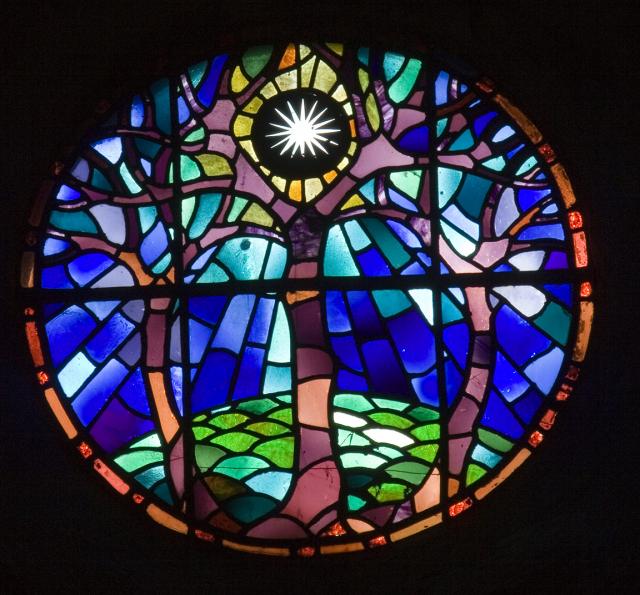
The icon uses the vine, leaves, grapes and animals, and Bailey uses ferns and sunflowers.   As Teilhard was all about seeing Christ in all things and God's love as an energy which fills all creation and pulls all things towards completion in Him, I think this idea of only God  can make things grow  is reflected in both the images.  St.Paul was, of course. very much an inspiration for Teilhard's idea of the Heart of Jesus, but by saying that 'only God can make things grow' we are reminded that we are all dependent on the grace of God.  The icon shows the living water which flows from the heart of the Saviour, nourishing all creation.  In Dom Theodore's window we see plant life blooming at the feet of Christ.  Both images remind us that only God can make us grow: to be devoted to the Sacred Heart is to trust in God's grace.  Without it we cannot grow.  This made me think of another window by Dom Theodore in St. David's chapel on the island of Caldey - which I last visited over twenty years ago! His theme here is the 'tree of life'. Perhaps we understand his (and our) Sacred Heart all the better when we take account of this window.  Can we read the Sacred Heart as the tree of life? The window as described by the Caldey website says that: 'It depicts a threefold tree, possibly symbolising the Trinity and the three crosses on Calvary. When illuminated by the afternoon sun, it gives a stunning sense of the power of the Creator breathing life and light into the world.'   (Go HERE) On this we can turn once again to the poem by St. Edith Stein quoted in the previous blog:


The Tree of Life, Theodore Bailey

In the heart of Jesus, which was pierced,
The kingdom of heaven and the land of earth are bound together.
Here is for us the source of life.

This heart is the heart of the triune Divinity,
And the center of all human hearts
That bestows on us the life of God.

It draws us to itself with secret power,
It conceals us in itself in the Father's bosom
And floods us with the Holy Spirit.

I think that IS what the Sacred Heart in these images prompts us to contemplate. The Sacred Heart as the source of love, light and life.

Monday, 3 September 2012

Saint Edith Stein and the Sacred Heart

The window by Dom Theodore has continued to provided much food for thought and prayer.  It was the feast day of  the great Carmelite saint, St Teresa Benedicta of the Cross - Edith Stein - on the 9th August which brought me right back to Dom Theodore's window and to our icon.  I came across a passage in her  book The Hidden Life   which  seemed to echo what the window is saying.

'The work of salvation takes place in obscurity and stillness. In the heart’s quiet dialogue with God the living building blocks out of which the kingdom of God grows are prepared, the chosen instruments for the construction forged. The mystical stream that flows through all centuries is no spurious tributary that has strayed from the prayer life of the church it is its deepest life.  ' (  See here  )

Reading her work is is apparent how she draws deeply upon the Carmelite tradition of the heart, and how central the Sacred Heart was to her spiritual life.  The evidence of her 'heart spirituality' is much in evidence in her writings.   In 1940, for example, she writes of the 'Hidden life and  Epiphany':


'When the gentle light of the advent candles begins to shine in the dark days of December a mysterious light in a mysterious darkness it awakens in us the consoling thought that the divine light, the Holy Spirit, has never ceased to illumine the darkness of the fallen world. He has remained faithful to his creation, regardless of all the infidelity of creatures. And if the darkness would not allow itself to be penetrated by the heavenly light, there were nevertheless some places always predisposed for it to blaze. A ray from this light fell into the hearts of our original parents even during the judgment to which they were subjected. This was an illuminating ray that awakened in them the knowledge of their guilt, an enkindling ray that made them burn with fiery remorse, purifying and cleansing, and made them sensitive to the gentle light of the star of hope, which shone for them in the words of promise of the "protoevangelium," the original gospel. As were the hearts of the first human beings, so down through the ages again and again human hearts have been struck by the divine ray. Hidden from the whole world, it illuminated and irradiated them, let the hard, encrusted, misshapen matter of these hearts soften, and then with the tender hand of an artist formed them anew into the image of God. Seen by no human eye, this is how living building blocks were and are formed and brought together into a Church first of all invisible. However, the visible Church grows out of this invisible one in ever new, divine deeds and revelations which shed their light ever new epiphanies. The silent working of the Holy Spirit in the depths of the soul made the patriarchs into friends of God. However, when they came to the point of allowing themselves to be used as his pliant instruments, he established them in an external visible efficacy as bearers of historical development, and awakened from among them his chosen people. Therefore, Moses, too, was educated quietly and then sent as the leader and lawgiver.'  ( Read here.)

This passage to me helps me to read Dom Theodore's window, but also to read the icon in a new way.   A relationship to Christ in the heart of of creation is one in which the light penetrates the human heart and illuminates it from within: it is an invisible process by which God's presence is experienced in the world.   This sense of humanity being open to the penetration of divine light is very much a theme in Teilhard.   And wherever we look in Saint Edith's work we find  the heart as that point in the universe in which God's light seeks to make a home.   A beautiful example is her poem: I Will Remain With You.


You reign at the Father's right hand
In the kingdom of his eternal glory
As God's Word from the beginning.
You reign on the Almighty's throne
Also in transfigured human form,
Ever since the completion of your work on earth.

I believe this because your word teaches me so,
And because I believe, I know it gives me joy,
And blessed hope blooms forth from it.

For where you are, there also are your own,
Heaven is my glorious homeland,
I share with you the Father's throne.

The Eternal who made all creatures,
Who, thrice holy, encompasses all being,
In addition has a silent, special kingdom of his own.

The innermost chamber of the human soul
Is the Trinity's favorite place to be,
His heavenly throne on earth.

To deliver this heavenly kingdom from the hand of the enemy,
The Son of God has come as Son of Man,
He gave his blood as the price of deliverance.

In the heart of Jesus, which was pierced,
The kingdom of heaven and the land of earth are bound together.
Here is for us the source of life.

This heart is the heart of the triune Divinity,
And the center of all human hearts
That bestows on us the life of God.

It draws us to itself with secret power,
It conceals us in itself in the Father's bosom
And floods us with the Holy Spirit.

This Heart, it beats for us in a small tabernacle
Where it remains mysteriously hidden
In that still, white host.

That is your royal throne on earth, O Lord,
Which visibly you have erected for us,
And you are pleased when I approach it.

Full of love, you sink your gaze into mine
And bend your ear to my quiet words
And deeply fill my heart with peace.

Yet your love is not satisfied
With this exchange that could still lead to separation:
Your heart requires more.

You come to me as early morning's meal each daybreak.
Your flesh and blood become food and drink for me
And something wonderful happens.

Your body mysteriously permeates mine
And your soul unites with mine:
I am no longer what once I was.

You come and go, but the seed
That you sowed for future glory, remains behind
Buried in this body of dust.

A luster of heaven remains in the soul,
A deep glow remains in the eyes,
A soaring in the tone of voice.

There remains the bond that binds heart to heart,
The stream of life that springs from yours
And animates each limb.

How wonderful are your gracious wonders!
All we can do is be amazed and stammer and fall silent
Because intellect and words fail.

And I Remain With You

( See Here. )

I think Teilhard would have loved this poem - as now I do! Saint St Teresa Benedicta of the Cross, pray for all those who seek the Sacred Heart.

Monday, 13 August 2012

Dom Theodore Bailey's Sacred Heart in Pembrokeshire (2)


Having travelled all the way to west Wales I found myself ( mentally at least) having to return to Paris once again!  For if I was to make sense of the stained glass window by Theodore Bailey, in Wales,  we have to wrestle with the French relationship to the devotion and to the image.   As a monk Dom Theodore was a member of a Benedictine  order which had itself played an important role in the history of the devotion.

Arriving in Paris in the early 1920s Dom Theodore would have experienced a high point in the history of the devotion: the great  Basilica had been completed in 1914 and was dedicated in 1919 ( the same year as the founding of  the Ateliers d'art sacré ). George  Desvallières and Maurice Denis's mission to renew and re-vitalize sacred art had obvious implications for the image of the Sacred Heart: the most prominent of all the ‘sulpician’ kitsch art which they deplored.  Dom Theodore was to be greatly influenced by his experience in Paris, but he was not to come back with the same kind of idea or image of  the Sacred Heart as that which he would have encountered in Paris. What we see is in many respects most unlike the work of his teachers.

George Desvallières had, by the time the young man from Caldey came to Paris, executed a number of Sacred Heart pictures.  Two pictures in particular had acquired some notoriety and acclaim prior to Dom Theodore’s visit.   The first, painted in 1905 showed Christ suffering with and for humanity. Jesus is not on a cross, so much hanging, as it were in front of the Basilica which was being built at the time.   It is difficult to imagine a less sentimental representation of the Sacred Heart as Christ is ripping open his chest to expose his wounded heart.  Later in 1919 – after he had (like Henri Pinta) lost a son in the First World War  he painted another Sacred Heart which again radically departs from the traditional image and explores the same theme of the Sacred Heart as a symbol of Christ sharing in the sufferings of humanity: the’ Drapeau du Sacré-Coeur’, for the Church of Notre Dame de Verneuil.  Not much by way of sentiment here, but a powerful portrayal of a Christ who is wholly and completely sharing in the pain of humanity.


Maurice Denis had also completedseveral works on the Sacred  Heart.  These are very different to the approach taken by Desvallières, and seem to focus on the Sacred Heart as a kind of golden glow of divine love.   In this respect they are very much in keeping with the ideas we find in Teilhard, and which he believed was expressed in his Henri Pinta picture.  In his 1894 painting Sacre-Coeur Crucifi  (right) Maurice Denis depicts the Sacred Heart as a golden glow: a light illuminating the darkness.  Later, he produced various versions of the same  image of a crucified Christ with a golden glowing heart upon which rests the Blessed Virgin.  He worked on one of these designs during the time Dom Theodore was in Paris, for the art deco church by the architect Auguste Perret, Notre Dame du Raincy. An oil on canvas version is ( I think) at the Musee du Hieron at Paray le Monial.

When we compare the images of the Sacred Heart by his teachers and that we find in the Holy Name in Pembrokeshire, we see no obvious points of similarity.    Indeed, if anything what we see in Dom Theodore’s window is a reaction against both the kitsch sentimentalism of the standard image but also a reaction against the kind of emphasis on suffering we find in Denis and Desvallières.  Dom Theodore’s Sacred Heart is a very much a monk's image: it is the Sacred Heart as a loving silence.  The Sacred Heart in this window above the tabernacle is a call to enter into the silence: it is a image which tells us that for the artist we have to be meek and humble of heart.  We have to be still and listen to the sound of the Heart of Christ: it is an image which is asking us to close our eyes and be silent.  In this was we can enter into the sacred heart of creation and be open to an encounter with God.   And I think this is what we see in this window: it is a window into the centrality of silence and humility in Benedictine spirituality.   If we desire to enter into the Sacred Heart we have to cultivate stillness and silence in our lives.  Thus although in Paris he encountered the Sacred Heart in terms of suffering and light, the experience of a monastic life led him to portray the devotion  to the Sacred Heart as a devotion to finding space for silence in our lives. This is the only way to understand our own heart and the heart of  God. Be still.  Be silent. Listen. A heart is beating at the centre of creation: it is the heart of Christ.  As a Benedictine Dom Theodore knew that silence is the path which leads to the deep mystery of the heart of the Saviour. To take up this path requires us to be wholly orientated towards the glowing love of God, like the sun flowers which always turn towards the sun, and ( fern-like) ever seeking to become humble of heart.

Well, such were my thoughts.

Sunday, 12 August 2012

Dom Theodore Baily's Sacred Heart in Pembrokeshire (1)


Interesting.  Since the last blog on the Benedictine tradition and the Sacred Heart, I have been in Wales and came across a beautiful and fascinating image by a Benedictine  monk, Dom Theodore Baily (1898-1966) .   Dom Theodore entered Downside Abbey in 1914, and later in 1920 went to Caldey (See HERE)  where he stayed  until 1928 ( when he move to Prinknash and later Farnborough – from 1947) .  In 1922 he went to Paris and spent some time  studying with Georges Desvallières and Maurice Denis at their famous Ateliers d’Art Sacré. (See HERE)  The following year, 1923, he returned to Caldey and was ordained in 1927. Whilst at Caldey, Bailey produced a number of impressive stained glass windows. It was one of these I discovered whilst paying a recent visit to Pembrokeshire.  I have been to the 'Holy Name' in Fishguard before – but never really noticed the stained glass window.  Which just goes to show how blind I was to the Sacred Heart until this icon project.  But now it seems that I see the Sacred Heart in all things and places!   I had come to Pembrokeshire with an eye to making a visit to the Cathedral at St. David’s and generally to explore the ‘Holy Land’ of Wales.  I was not really looking for the Sacred Heart, but it seemed to find me and led me to new paths and avenues to explore, and prompted me to re-trace some old ones.

The window has an ‘iconic’ feel to it - well that is what I immediately thought when I saw it and is clearly operating on a more symbolic level than the usual image of the Sacred Heart – there were a number of the usual sort in the church.  High in the apse of the church, directly above the tabernacle,  the window is a powerful focal point for the congregation and you are naturally drawn to it- sadly a huge cross as been erected one side and rather detracts from the window.  Pity really.   The detail is such that it is only when you  study a photograph of the window that it is possible to appreciate the considerable artistry of  Dom Theodore, and marvel at the way in which he has chosen to represent the Sacred Heart.  Considering the fact that in was produced in the 1920s, when there was so much awful sentimentalized stuff around - precisely the kind of stuff Teilhard disliked -  it is a truly an outstanding piece of  modern sacred art and shows how much the young monk had learnt from his studies in Paris.

The face has none of the characteristic kitchness associated with the traditional type of Sacred Heart.   Christ is not looking up to heaven as is often the case in images of the  Sacred Heart or looking at us in the way in which He is normally portrayed.  It is a strong and powerful face.  The kind of face we see in icons, rather than Catholic traditional representations.  He is wearing the crown of thorns and his garments are purple in part to signify His universal kingship.  ( The feast of Christ the King had been instituted by Pius XI, in 1925.)   His  hands show his wounds and do not point to his heart.  The heart  itself is a simple red centre surrounded by a golden  light or glow.  Christ does not look up to heaven because he is in heaven – as represented by the blue glass.  Neither is he looking at us.  What we see instead is Christ whose eyes are closed as if in a state of prayer or meditation. Perhaps in this he was influenced by the Sacred Heart of another French symbolist (we explored earlier in this blog) who had died in 1916 - Odilon Redon.  In his Sacred Heart Jesus’s eyes are also closed in a very ‘eastern’ way: as if in deep meditation.  One of his teachers in Paris  (Maurice Denis) evidently  knew Redon – indeed Redon painted his portrait in 1903 – so it is not inconceivable that that Dom Theodore would have known of Redon’s Sacred Heart.  Denis himself had painted several pictures of the Sacred Heart, and in the period when Dom Theodore was in Paris, he designed the windows in the Notre Dame du Raincy – designed by Auguste Perret.  One of these depicts the Sacred Heart. Earlier Denis  he had pained a picture of the Sacred Heart Crucified (1894) with a ‘golden glow’.   George Desvallières ( a third order Dominican, like Felix Ville) had also painted pictures of the Scared Heart in 1903 and 1919  and painted several others in later years.  However, what is common in all their Sacred Heart works is, like Theodore Baily’s window, Jesus does not have that (rather effeminate) ‘look’ we associate with the  standard image.  That comes across very clearly when we compare the face of Christ in this window with those of his teachers in the Ateliers d’Art Sacre.  I will deal with this in another post.

Together Denis  and Desvallières set out to challenge ‘l'art St. Sulpice’.   So, the decision by Theodore Bailey to study with them was quite a radical move by the young Benedictine.  The more we look at the window and understand the influence of his experience in Paris in the  Ateliers d’Art Sacre, the more significant becomes this beautiful window.  It deserves to be much better known.

The lower half of  the window is suggestive of so many thoughts and ideas.   It provides so much material upon which we can reflect and I wonder how over the years this window has served to aid the prayer of the faithful who have gathered underneath its gaze.   The artist employs two symbols which are not usually associated with the Sacred Heart: fearns and flowers.  

Ferns are symbols of humility.  Is Dom Theodore’s window asking us to understand that, if we are to be one with the heart of  the Saviour,  we too must be meek and humble of heart?   If we are to grow and unfold as Christians we have to learn from the humble fern.  The fern, of course, grows in the shade and under the protection of great trees.  Is Christ in this window the great tree of life: the crucified one who hung upon a tree at Calvary?  And we are, perhaps, the unfurling fronds: the signs of new life awakening in Christ?  The ferns are, it appears, growing towards the light of the world.  It is significant that the artist uses small newly emerging fearns – all tight little spirals that will grow and complete themselves is this new light glowing at the centre of the window.  Here the Sacred Heart is a centre which is calling to our centre: calling us to unfurl and evolve.

The flowers are more of a problem.   I  am not sure what flowers they are supposed to represent.  At first hey brought to mind the lines in Mathew 6.26: is the artist asking us to remember the flowers of the fields  who sow not neither do they spin?  To be one with the heart of  Jesus we have to trust  God wholly and completely?  In which case is the window asking us to reflecting on the prayers so much associated with the Sacred Heart: “Jesus meek and humble of heart make my heart like unto yours.”.  And: ‘ Sacred Heart of Jesus, I place all my trust in you’.   On  other hand, they do look rather like sunflowers. Reflecting on these I thought that perhaps the artist is using the sunflower as symbol of the soul which, like the sunflower always turns and seeks out the light of the sun?  Is the Sacred Heart the great sun towards which we must grow if we are to realize the  fullness of our humanity in Christ?  The  Heart of Jesus’ our light and salvation’.

Yet another interpretation suggest itself.   As the litany to the Sacred Heart expresses it: the heart of Jesus as the ‘gate of heaven’.   Perhaps what we are asked to consider is Christ as the gate into the heavenly garden which awaits the humble and the meek of heart who have trusted in God’s infinite mercy and love?   And perhaps the window asks us to read the symbols as Christ Omega ( like our icon): here Jesus is gathering all creation to himself.  In this sense the young fronds represent the new creation unfolding and becoming one in Christ in the new heaven and new earth? However we interpret the images and symbols, it is ( I think) obvious that Dom Theodore is inviting us to reflect upon  the fern and the (sun) flower.   By using these symbols the artist is clearly – to my mind -  calling us to think and reflect upon the Sacred Heart in terms of  flora: two powerful  symbols of growth and life nourished by the living water which springs from the heart of  the Son of God and the light and fire which emanates from the ‘burning furnace of charity’ in the centre of the window.

In short, I found myself reacting to this image in an iconic way.  That is, the artist requires us to read this image: it asks us to do some work and exercise our mind and heart.  It is a window through which we have to see the Sacred Heart afresh and anew. His image, like those of his teachers is attempting to go beyond the traditional image and bring it into the twentieth century.

Given this, I was interested when I came across some comments by  Dom Aidan Bellenger  (HERE) who noted of Dom Theodore that:

‘His was a spiritual and withdrawn disposition and there was nowhere he liked to be better that the two-roomed cottage hermitage at Caldey known as Sambuca.  His interests encompassed the English mystics. and the spirituality of the East... Baily’s milieu was rather Eastern Christianity. This was reflected in the artistic work which engaged his energy and imagination;  his paintings are suffused with an iconic Byzantine style’

A little more research revealed that this interest in the iconic and Byzantine style in to be found in a more explicit form in his other work. This can been seen in several works: as in the Virgin and Child ( left ) and two windows in Caldey (above right).  What we see in the Sacred Heart window in the Holy Name is a kind of fusion between his interest in icons and what he had learnt or taken from his time in Paris.  Whatever the actual influences, the window itself is exceptional and repays careful and considered reading.