Thursday, 29 September 2011

Feast of St. Michael, St Gabriel and St Raphael

I have already blogged about our two Archangels ( Michael and Gabriel)  (See blogs for  25th /26th August 2011) But, of course, we cannot see  Raphael with them in our icon. Sometimes in life, however,  what is not there or  what does not happen is just as important as what is there or what does happen.   And so it is today.  As we celebrate the feast of St  Michael, (right)  St Gabriel (left) and St Raphael, it is the absence of the latter from the icon that is just as significant as the presence of the other two!  Raphael is the archangel we do not see in our icon  – or perhaps he is  just the angel we cannot see.

Verrocchio's St Raphael and Tobias

St. Raphael is unique in that he is an angel who is a central character in a book  of the Bible : The Book of Tobit. The structure of the story is fascinating because in it two or three  stories are woven together to show that God sees how all things interconnect.  All things converge.   The book of Tobit weaves together several apparently unconnected   stories: the blindness of Tobit in Nineveh and Sarah in Media whose prayers 'found favour with the Lord'.  Raphael is despatched to cure - with the liver, heart and gall bladder of a fish- Tobit of his blindness and to rid Sarah of a troublesome devil (Asmodeus) who kills her husbands before their marriage can be consummated.  He then ensures that Tobias ( Tobit's son) gets to marry Sarah, deals with the devil and then they all live happily ever after.  In paintings  (as right -> ) Tobias is often portrayed as  carrying the fish whose internal organs were used to cure his father's blindness and scare off Asmodeus. 

Seeing is a central theme of the story of Tobit.  God sends Raphael to help cure Tobit ‘s blindness.  Just as his father cannot see, Tobias is also blind :  for he cannot see that Raphael is an angel,  and not just a 'Mr. Azarius' who is being paid as his guide. At the close of the story Raphael tells them that he is not really Mr. Azarius, but an angel: and not just any angel, but ' one of the seven angels who stand ever ready in the presence of the Glory of the Lord'. And, although they saw him eating, he tells them that  it was all just an illusion: then rises in the air and becomes invisible. ( But was he ever truly visible?) 

The story has been very popular with artists over the centuries.  There are numerous  pictures that  portray Tobias and Raphael on their adventures.   And,  as in the picture by Verrocchio in the National Gallery in London, (above)  we see the archangel in all his splendour , but Tobias just sees  Mr. Azarias, his paid guide and mentor.

For an icon which has been inspired by Teilhard  - who wants us to SEE the Sacred Heart in a more universal way - it is providential that we do not actually see Raphael, the healing  angel who can restore sight.  (Raphael means ‘ It is God who heals’. )    

Lippi's picture (1485) showing all three Archangels with Tobias
Like Tobias and Tobit, and Anna (Tobit's wife) and Sarah we cannot see Raphael in this icon.  But also like them, however, we need to realize  that ‘It is God who heals’.   We, like them, can only see  God in all things by the grace of God.  To see God and God’s messengers is a gift.  Great mystics – and I would say that Teilhard was one of the great mystics of the 20th century - can see Christ in all things.  But we who have not been given  this grace invariably only  see a Mr. Azarius and not ' one of the seven angels who stand ever ready in the presence of the Glory of the Lord'. ( So we know that Raphael is somewhere in this picture!) We  see an icon: a window which can help us see God more clearly.  So, the  fact that we do not see Raphael in our icon is a reminder that we must pray for the grace to see Christ with our hearts and pray that Raphael will come and heal our spiritual blindness and open our hearts to God's presence in the world and open our hearts to the ministrations of his angels, however they appear to us.  (And get rid of our personal devils!) 


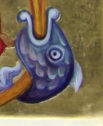
My guess is that if St Raphael is anywhere on the icon he is nearby the fish and the flowing water * wondering what he can do with their liver, heart and gall bladder!  So watch out  fish,  Raphael is about! 


*It is  Raphael  who is traditionally supposed to move the waters  and heal the sick at the sheep pool at Bathesda mentioned in John (5: 1-4) .

Monday, 26 September 2011

Welcome to the Cherubim and their many eyed wheels!


Because the Sacred Heart  is a devotion  which is so focused on an image, how we make sense of the image is crucial to the prayer life it fosters.    The theme of seeing is a major one in Teilhard’s writings on the Sacred Heart.  Teilhard believed that we had to see this very familiar Catholic images in a different way: he wants us to see it less in terms of the  Botoni type images, and more in terms of light and energy.  His Sacred Heart is a golden glow.   Reflecting on the Redon images the other day  it struck me that we have to be open to the various stages and phases in the evolution of the image.   As we reflect on the earliest representations  and the more recent explorations – such as our icon  - I do not think this means that we have to abandon seeing the Sacred Heart through these other representations.   To  understand the Sacred Heart it is necessary to be aware of  the evolution or the unfolding of the image.  And with that in mind, I turn to a part of the icon which I have yet to explore : the Cherubim  that  we find at the bottom of the picture.  When we look at the Cherubim (represented here by their wheels of the chariot of God)  we notice that their wheels - or the Ophanim - are covered by eyes.*   For a icon which is about an image which embodies the old and the new aspects of the Sacred Heart the presence of the Cherubim (with their 32 eyes) and their wheels ( the many eyed Ophanim) are  very welcome indeed.  We need all the eyes we can get!  So, if I haven’t said it before: good to see you Cherubim. Welcome.   I think that the Cherubim  and their  many eyed wheels will help us to see the Sacred Heart more clearly  and love it more dearly.

Definitely NOT Cherubin, but putti! (by Raphael) 
What are usually called Cherubim are, of course, ‘putti’ and are certainly not to be mistaken for Cherubim!   Putti are the ‘cute’ little boys who, despite their chubbiness manage to  fly around all over Renaissance, Mannerist, Baroque and Rococo paintings conveying the sense of ‘love’.  The Cherubim are many things, but cute, and like putti, no they are not!

We first meet Cherubim in Genesis.  Poor old Adam on the far left of our icon must feel  uncomfortably close to the Cherubim for they remind us that when he and Eve were thrown out of heaven it was the Cherubim who were posted outside the gates to make sure that he they did not try to get back in! (Genesis 3:24) As I read it, if Adam and Eve had not eaten the forbidden fruit they might well have ended up as Cherubim: attending on the Deity in the garden.


Blake: ‘The Whirlwind'
Here in our icon they are angels whose task it is to serve as bearers of the throne of God ( as well as guarding the Sacred Heart as the ‘gate of Heaven’ ) .  The Cherubim are the angels who transport God around His creation.   Most famously they appear in Ezekiel where they are described in some detail. They are portrayed as having four faces which represent different realms  or aspects of nature: lion ( nature  as wild-life) an Ox ( as domestic animals); eagle ( the air) and finally the face of a man (homo sapiens) .  These four angels with four faces each are all joined together  spinning around on  wheels on fire  (the many eyed Ophanim) .  There have been numerous attempts to try and represent the description we find in Ezekiel.  But what they all have in common is their attempt to capture the sense of the Cherubim as a powerful whirlwind of energy and driven by the power  the Ophanim  - the  wheels within wheels which are covered with eyes ‘like burning coals of fire’.    Perhaps one of the most famous attempts to illustrate Ezekial ( 14-28) is by Blake: ‘The Whirlwind: Ezekiel’s  Vision of the Cherubim and Eyed Wheels’.

The many eyed wheels - the OPHANIM
In terms of a more iconographic representation, the one which well captures the sense of whirling energy of the Ophanim is to be found in the Church of St. John the Baptist in Kratovo (pictured on the right) .  (See HERE)

There is much that can be said about our Cherubim and Ophanim which are bearing the throne of Christ Omega, but for this blog it is enough to say that they do two main things (I think).  The first is that they remind us of three of the litanies of the Sacred Heart in particular.

Heart of Jesus, Holy Temple of God.
Heart of Jesus, Tabernacle of the Most High.
Heart of Jesus, House of God and Gate of  Heaven.


Tissot, 1900
It is the Cherubim who were used to adorn the Ark of the covenant, and they adorned the Temple in Jerusalem.  So, they serve to remind us that Jesus is the new Covenant.; the Temple Of God; the Tabernacle of the Most High; and , of course,  the responsibility of the Cherubim is also to guard the House of God and the Gates of heaven  - and that is how the Sacred Heart is described in the litany.  So, once again, the icon serves to connect the Sacred Heart with its scriptural context:  the Cherubin provide as with a window through which we can reflect on those three litanies.  And, of course, their presence in an icon of Christ Omega - a Sacred Heart of the Parousia -  reminds us that the Cherubim appear in the Book of Revelation (4.6). Thus our icon is shown as rooted in scripture and thereby provides a doorway into exploring the wider theological and Biblical context of the Sacred Heart.  (As the summa of our faith.)  Above all the four heads of the Cherubim also connect our thoughts and prayers with the four gospels as they represent the signs of Mathew ( winged man)  Mark, (lion)  Luke, (ox).and John (eagle). ( I try, for example,  to reflect on the idea of the 'heart' in the Gospels when I use this icon.) 

Secondly, the Cherubim  also have so much to contribute to our understanding of the Sacred Heart from a teilhardian perspective.  The Cherubim and their Ophanim are, I think, yet another key to opening up and expanding our understanding of the Sacred Heart  that Teilhard found in St. Paul and St John.  But that is another blog!  At least I have now introduced the Cherubim and their many eyed wheels ......there is a lot more to be said. **

=============
* One authority explains that  ophanim are often seen as the 'thrones' mentioned in St. Paul : 'The 'thrones'; also known as 'ophanim' (offanim) and 'galgallin', are creatures that function as the actual chariots of God driven by the cherubs. They are characterized by peace and submission; God rests upon them. Thrones are depicted as great wheels containing many eyes, and reside in the area of the cosmos where material form begins to take shape. They chant glorias  to God and remain forever in his presence. They mete out divine justice and maintain the cosmic harmony of all universal laws.' Rosemary Ellen Gullen, Encyclopaedia of Angels, Facts on File, 2004


**Meanwhile...There is so much wonderful music written concerning the Cherubim. One of my favourite pieces is Tchaikovsky's  hymn of the Cherubim.  Listen HERE.

As to the wheels, let us not leave them out.  Great song  ( sang it in the choir when I was a kid ) 'Ezekiel Saw That Wheel'.  Here it is sung by ( who else but) Woody Guthrie: HERE

Sunday, 25 September 2011

Odilon Redon's Sacred Heart

Reflecting a little more on Teilhard’s story ‘The Picture’ about which I blogged  earlier, (HERE)  I have been musing about what artist – if any – has explored the Sacred Heart in the kind of way we find in Teilhard’s story.  And my mind has been drawn more and more to the Sacred Heart by by the French Symbolist  artist, Odilin Redon ( 1840-1916).   I  doubt if Redon can be said to be expressing a particular 'Catholic' idea of the Sacred Heart.  His own spirituality was what we might now term somewhat 'new age'   - he had an interest in Eastern religions and he was also fascinated about the relationship between evolution and religion.  His work is full of reflections on evolution.  But what is of interest here is the fact that we can see what a 'symbolist' made of the most popular image in French Catholicism during the late nineteenth and early twentieth century.   He was not the least interested in politics, at the time when the Sacred Heart was a very political symbol in France, but it is clear that he wanted to see the Sacred Heart in a very different way to its traditional naturalistic representations. So his images did challenge an important convention.    The images he produced stand in complete contrast to the naturalistic 'Botoni' type that dominated - and still dominate - and  can be read as attempts to look at the symbol in a radically different way.  His exploration of the symbol of the Sacred Heart has, therefore, some relevance to our journey to the Sacred Heart.

I have long been a  fan of Redon’s work – but I must confess that I was not really aware of his Sacred Heart picture until I started this blog and it  really took me by complete surprise.   However, of all the images of the Sacred Heart I think   or feel that his pictures comes closest to capturing a little of what we read in Teilhard’s story.  In Teilhard's story we have the idea of the image of the Sacred Heart as 'melting', unfolding and expanding and enveloping  and I think we also get this sense of watching a dynamic unfolding process ( called the Sacred Heart) rather than a static image in Redon's picture.  *  I think this sense of the Sacred Heart as a dynamic unfolding cosmic process is what Teilhard is exploring in his story.  From this picture I think that Redon is also seeing the Sacred Heart as a symbol of unfolding or flowering love -  as divine energy and light.  

Redon's picture (completed in 1910 ) shows us a Sacred Heart which has something in common which the later picture painted by Henri  Pinta (1921)  (< - left) also captured for  Teilhard: the heart as a golden diaphanous glow.  The heart for Redon is seen as  a glow of light and radiating (cosmic) energy. As with the Pinta image, therefore,  in Redon's pastel we see a  picture of Christ in terms Resurrection and Transfiguration.   The sense of the Sacred Heart is conveyed by the use of black spikes ( with red tips around the ‘heart’ ) and they suggest the crown of thorns around the head. **   Traditionally the Sacred Heart is shown looking directly at the viewer.  But Redon had a preference for heads drawn or painted in profile or with the eyes closed. The closed eyes also convey a sense of the humility of Christ: Jesus who is humble and meek of heart.   It suggests to me that  that we too must close our eyes and reflect humbly upon our own hearts. Here we see Christ who is not looking at us, but is deep  in contemplation and prayer – and I find that it invites me to close my eyes and pray.  As in Teilhard’s story we see a Christ whose image is in the process of loosing its defined outline.  We get a sense of Christ as in the process of being consumed but also consuming and of infolding and converging.  Another feature which is quite subtle, but again echoes what we find in Teilhard is the sense of the Sacred Heart as involving a process of 'centering'. The 'spikes' coming out of the heart are curving and  point our eyes towards the outer circle surrounding the nimbus around Christ's head - which is surrounded by a mysterious black circle.  The whole composition seems to have a sense of swirling movement, pulling us in to the mystery the Sacred Heart.    I find it a most compelling image.


Another picture by Redon  (dated c 1900) that also explores the symbol of the Sacred Heart,  entitled ‘Christ and the Samaritan Woman’, and is subtitled 'The White Bouquet'  shows Christ’s heart like a bouquet of flowers formed from bubbling and glowing  liquid light, as he tells her that he is the ‘living water’.   The heart here is being offered as a beautiful bouquet of flowers rather than a literal heart. *** The Samaritan woman is shown facing Christ with her eyes closed.   It is as if she is reflecting on the meaning of what  Jesus has told her: that he is the living water.  He is the source of a spring of life-giving water that flows from His heart. And between them is a glowing red (heart) shape sparkling with blue and gold which perhaps symbolises how, in prayer and contemplation of that mystery, her heart and the Sacred Heart of Jesus are in the process of entering  into a new relationship of love.  Heart is speaking to heart.   As with his Sacred Heart picture above,  we get a sense of movement with the circles within circles: the flowery heart appears to be comprised of discs of light moving in and around one another.  And again, as with the  Sacred Heart picture - but even more so - we see Christ without border lines.  As in Teilhard's story, Christ is melting, emerging and unfolding.  In this picture Christ is 'flowering'.  Contrast Christ with the woman.  She is very solid and static: whereas Christ is more of a golden glow than a solid or static body. 


So for me the pictures by Redon are very evocative of  Teilhard, but they also evoke the litanies of the Sacred Heart, especially:

Heart of Jesus , in whom are all the Treasures of Wisdom and Knowledge. 
Heart of Jesus, Fountain of Life and Holiness. 
Heart of Jesus, source of all Consolation.

I think the Redon's Sacred Heart picture prompts us to reflect on the Sacred Heart as the dynamic  'Furnace' of God's love that we find in Teilhard's story.  And the picture of  'Christ and the Samaritan woman' invites us to think of the Sacred Heart in terms of a different and opposite symbol : not just as fire but as the source of  living water.  God's love as a flowering or unfolding within us brought about by his living water flowing through our heart.   In turn, these ideas take me back to our icon of Christ Omega where Ian has thoughtfully included both the symbol of fire at the centre of the icon, but also the symbol of flowing living water which is nourishing the unfolding and flowering  of  God's love in our heart. ( The picture  of 'Christ and the Samaritan Woman'  also reminds me of St Mary Magdelene in our icon. She is first to see Christ after the resurrection and she takes him for a gardener!  Perhaps, as St. Therese would expressed  it, Christ sees us all as his flowers.  

===
* Redon once said' With my eyes more widely opened upon things, I learnt how the life that we unfold can also reveal joy.'  This idea of life as a process 'unfolding'  is very much present in the picture.  
**This is marked contrast to the picture of Buddha which is very similar to his drawing of the Sacred Heart.
***  The notes on the picture at the Stadel Museum in Frankfurt am Main states ' The artist painted the incident reported in the Gospel of John, in which Jesus asks a Samaritan woman for water, on two occasions. This later version was probably painted in the late 1890s, in the second phase of Redon’s career, in which he focused on colour. In an unreal, swirling play of colours, the silhouettes of the two figures merge with the reddish-brown background. The white bouquet (which is also the painting’s subtitle) shines with a glittering, mystical light in front of Jesus’ breast'

Friday, 23 September 2011

St Pio and the Sacred Heart: Feast of St. Pio of Pietrelcina

Today is the feast of one of the most popular saints of the 20th century, best known as  simply 'Padre Pio'.   My favourite saying of St. Pio was ' Pray, hope and don't worry.'     When things get tough I try to remember his advice: 'PRAY, HOPE AND DON'T WORRY'.  The reading at today's mass from the Prophet Haggai tells us the same thing with reference to the building of  a new Temple which will 'surpass the old' : ' Courage....To work!  I am with you ..and my spirit remains among you.' In other words, pray, and just get on with your life - build for the future without fear and worry.  As Teilhard would put it - stop worrying and build the new earth, for it will surpass the old.

So many problems that we face as individuals and as societies are ( as Teilhard frequently observed)  the result of being unable to do or to act because we lack confidence and hope.  Instead of getting on with life, we worry.  ( Today's newspapers are full of worry. Worry - fears about uncertainty - has profound and far reaching economic as well as political and social consequences!) Worry - fear and uncertainty about what may or may not happen - can freeze us and incapacitate us and inhibit our capacity to be creative and productive human beings focused on building the  future.  We lack energy , we lack what Teilhard refers to as ZEST!  ( SEE THIS POST) When we stop worrying as individuals and societies  - when we refuse to be held captive by worry and uncertainty - we can realize our hopes, but when we are prisoners of  worry we have no hopes to realize. Worry eats away at our zest for life.  On the other hand, prayer and hope can empower and energize us : when we open our hearts to God in prayer we are  re-kindling and re-fuelling our zest for life.

St Pio had a great devotion to the Sacred Heart  and his Novena to the Sacred Heart is well known and much loved.    (Download it HERE)  I think this will be my morning prayer  - and my  antidote to worry - for the next nine days.

So, with the advice of this holy man before us, today's prayer is simple enough:

Sacred Heart of Jesus,  zest of the world:  in your infinite mercy, fill us with the glowing energy of your love.  Help us to pray. Help us to hope. Help us not to worry.  We place all our trust in you.

Thursday, 22 September 2011

The Sacred Heart for Dummies

I was re-reading the other day a book by Prof Stuart Kauffman * and I  was reminded of something Prof. Steven Weinberg said which  I think perfectly expresses the very opposite of what Teilhard is  really saying about evolution.  Flip Weinberg's  argument around and you have a statement of  what Teilhard is saying about the Sacred Heart for dummies.  

Prof. Weinberg argues that : (1)  ' The explanatory arrows always point downwardwards'.   That is to say,  the universe can all be explained by reductionist thinking: everything in the universe (including us human beings)  can be explained by analysing the parts which make up the universe.  And  (2) :  ' The more we comprehend the universe, the more pointless it seems'.  Which means that the evolution of the universe simply has no purpose or direction: it is utterly pointless. And religion  is therefore a (dangerous) waste of time.

Teilhard's whole message was that we, as Christians,  had to embrace evolution as driven and powered by God : the arrows point upwards, to understanding the wonderful complexity of life seen in the whole which emerges from the parts and  which is infinitely more complex than just the sum of its parts.  And because of this, the MORE we comprehend about the universe, the MORE direction and purpose and design we find.  But, of course,  the design is evolutionary in nature: our God is ( as Teilhard expresses it on his  Sacred Heart card -SEE HERE -) a God of  evolution.  Evolution is therefore holy and creation is thereby made sacred.  The complex web of existence that has evolved over billions of years is  the work of a divine power and energy. We find God in what science is telling us about the marvellous complexity of matter and human consciousness.  We see God's handiwork in the evolution of that complexity.   As Blessed John Henry Newman figured out a long time ago, evolution is  simply not a problem for those with a belief in God**:  it just makes God's design MORE wonderful ( yes, and even more intelligent!!) than our ancestors could have possibly imagined.

Instead of standing on the sidelines, therefore,  Christians and  all those who share a belief in the God of Abraham must move more into the centre ground of the debate. ***  Evolution  does not open up a great gap between faith and reason and between science and religion:  it is the great bridge between them.   This dialogue between science and religion is what Teilhard passionately believed HAD to happen if Christianity - and religion generally- was to remain relevant to the modern world.  Yes, we acknowledge the FACT of evolution, but we must proclaim - like him - that we see in this fact a process with purpose and direction. So our reply to Weinberg  and company is to join with Teilhard in arguing that: the universe has does have a point, and it is not pointless.   Look, it  is there at the very centre of the icon: the Omega point of  divine love.  That is the whole point of evolution!   So, we should say, as we read our New Scientist or our Scientific  American  - that, contra what the Weinbergs of the world stridently  proclaim, the more we comprehend the universe the more do we find the purpose and end of it all: God, the Creator,  whose presence shines through all creation if we but open our hearts to see Him at the heart of all things.   That is pretty much the Sacred Heart for dummies - and fundamentalist reductionists of the both scientific and religious varieties.

========

* Prof. Stuart A. Kaufman's 'must read': Reinventing the Sacred: A New View of Science and Religion, Basic Books, 2010. A topic for another post, perhaps.
**In a letter in 1868 , for example, Newman noted that:  'As to the Divine Design, is it not an instance of incomprehensibly and infinitely marvellous Wisdom and Design to have given certain laws to matter millions of ages ago, which have surely and precisely worked out, in the long course of those ages, those effects which He from the first proposed. Mr. Darwin's theory need not then to be atheistical, be it true or not; it may simply be suggesting a larger idea of Divine Prescience and Skill. Perhaps your friend has got a surer clue to guide him than I have, who have never studied the question, and I do not [see] that 'the accidental evolution of organic beings' is inconsistent with divine design—It is accidental to us, not to God.'

Letter to J. Walker, 22nd May 1868:  The Letters and Diaries of John Henry Newman, Oxford, Clarendon Press, 1973. Full letter HERE.

** *And, of course,  not just Jews, Christians and Muslims but all people of faith.

Tuesday, 20 September 2011

Teilhard’s Litany: (14) The Pyx

 For most of us the only time we see a pyx is when we are ill at home or in hospital and are unable to attend mass. So the third story 'The Pyx' (Read here in  The Hymn of the Universe)  has a strong personal resonance for all of us who have been incapacitated in one way or another.  But it also very personal to Teilhard.   We know from his letters that he frequently – like all priests in the army – would carry a pyx on him containing the Blessed Sacrament.   The story also contains explicit factual information that suggests that this story might be considered his thoughts as he was to go into battle himself.  The story tell us that his friend had been at Verdun and that he was due go to Douaumont to recapture the fort.  It concludes with the report that his friend in the battle – so perhaps Teilhard was musing on his own fate as he wrote this story.

It is a simple enough story about a priest who carrying a pyx finds himself  in a dug-out gives himself holy communion.  Teilhard then describes his ( friend’s?) thoughts and feelings about the experience.  So it is not as ‘vision’ as such  so much as a ‘more general impression’ which ‘affected his whole being’.

The story provides Teilhard with an opportunity to give a some concise statements about  his way thinking.   Again, these are early ‘impressions’ which are to be explored and enlarged in the years to come.

What the story conveys in the intensity of Teilhard’s belief in the real and true presence of Christ in the bread and wine.  He was to write a good deal about this.  More than anything else I would say that the icon has served to focus my thoughts and prayers on the Eucharist and how it is a powerful outward sign of the process in which Christ is uniting all things.  As is evident in his prayer in the `mass on the World’  for Teilhard it is in communion  with Christ in the Eucharist that we come closest to the Sacred Heart.  The story of the picture is about an image, the  story of the monstrance is about the diaphany of God, but the story of the pyx is about the experience of consuming and being consumed by the golden glow radiating from the heart of Jesus.

He begins my summarising what the previous two stories have told us about the universal processes at work in the Sacred Heart: ‘ a cosmos in which the dimensions of divine reality , of spirit and of matter were also intimately mingled’.   His heart, he tells us began to ‘burn’ with a ‘higher vision of things’.  He then proceeds to tell us the story of how a  priest  carrying the Blessed Sacrament becomes overwhelmed by the desire to possess, penetrate and assimilate ‘the wealth of the world’.  And yet, try though he may, he cannot pass through the invisible barrier  - ‘the thin , barely-formed film’ that separates Christ from himself.


In reflecting on the mystery of the Eucharist Teilhard declares himself a pantheist.   Now at this point critics of Teilhard will shout ‘got you!’  But of course, by a pantheist he means in the sense we find in St. Paul: En pasi panta theos – God all in all.  For Teilhard the Eucharist is a  pantheoetical  (can I say that -  is that a word?)  experience: that is its to say in the Eucharist we become one with God.  We consume and are consumed.  In the Eucharist humanity is being progressively assimilated into the mystical and cosmic body of Christ! 


I live at the heart of a single, unique Element, the Center of the universe and present in each part of it: personal Love and cosmic Power. To attain to him and become merged into his life I have before me the entire universe with its noble struggles, its impassioned quests, its myriads of souls to be healed and made perfect I can and I must throw myself into the thick of human endeavor, and with no stopping for breath. For the more fully I play my part and the more I bring my efforts to bear on the whole surf ace of reality, the more also will I attain to Christ and cling close to him.

God, who is eternal Being-in-itself, is, one might say, everywhere in process of formation for us.

And God is also the heart of everything; so much so that the vast setting of the universe might be engulfed or wither away or be taken from me by death without my joy being diminished. Were creation's dust, which is vitalized by a halo of energy and glory, to be swept away, the substantial Reality wherein every perfection is incorruptibly contained, and possessed would remain intact: the rays would be drawn back into their Source, and there I should still hold them all in a close embrace.


This wonderful passage reflects the way in which Teilhard was thinking about the Eucharist and the Mass.  The following year he wrote an essay called ‘The Priest’ which prefigures his great ‘Mass on the World’.

Teilhard saying mass before the battle for Douaumont, 1916
The story concludes with an inspiring statement from one who was just about to go off to a battle field.  It shows how the Eucharist had given him a strength and a courage that  ‘ even war’ does not ‘disconcert’ him – as one ‘instinctively in communion with life’.   He tells us that he will go with a religious spirit and that if he is not to return he would like his body to be remain in the clay of the fortifications of the fort in Douaumont  ‘ like a living cement thrown by God into the stone work of the New City’. 

The story serves to remind us that in all of the language he uses to describe the Sacred Heart, we must always remember that above all else, the Sacred Heart is to be experienced in the Eucharist. And, when we take communion what we consume and what we are being consumed by is the cosmic and universal energy described in the litany on his card.  (See HERE)

Teilhard's Litany: (13) The Monstrance


For Teilhard the Eucharist is where we experience a communion with the Sacred Heart.   Indeed, the Eucharist is the Sacred Heart. Thus the two other stories in Christ in the World of Matter are about the Eucharist.   In Teilhard's story ‘The Monstrance’ ( READ in  The Hymn of the Universewe have a beautiful and inspirational account of an experience during an adoration of the Blessed Sacrament.   I have blogged about the adoration of the Blessed Sacrament a few times already, but the relationship between the Sacred heart and the adoration of the  Blessed Sacrament is central to our experience of the Sacred Heart and it was so for Teilhard.   Indeed, I would go further and say that the adoration of the Blessed Sacrament is central to the future of the Church.  And its revival in recent years is to be welcomed. 

I think the story of ‘The Monstrance’ is much easier to understand at first reading than ‘The Picture’.   Its theme is very much the same however: the presence of Christ in all things.   At the outset Teilhard uses a word which is a key word for him: diaphanous.   The story begins with a description of a diaphanous light that illuminate the crystal and designs within a lamp.  For Teilhard God’s presence within all things is ‘diaphanous’ : it is an inner light which fills all creation.  The presence of Christ is transparent in the universe.   The light of Christ is shining through all creation: we just have to ask for the grace to SEE it.  In the story his friend is given the gift of experiencing the 'diaphany of God'. In the The Divine Milieu he writes that with this gift we are given the grace to the world in a new and enhanced way. 


like those translucent materials which a light within can illuminate as a whole [we see ]...  the world bathed in an inward light ... It is the calm and powerful radiance engendered   by the synthesis of all the elements of the world in Jesus.. If we may slightly alter a hallowed expression, we could say that the great mystery of Christianity is not exactly the appearance, but the transparence of  God in the universe.  Yes Lord, not only the ray that strikes the surface, but the ray that penetrates, not only your Epiphany, Jesus, but your diaphany. (The  Divine Milieu, Torchbooks, p131)


The green desk lamp with its diaphanous light reminds his friend of another occasion when he had a powerful mystical experience of the diaphany of Christ.   As his friend was kneeling before  the Blessed Sacrament exposed in a monstrance he experiences a vision of the white host  spreading out into the  world – like a spot of oil or a silver wave or a fire spreading over a heath   and illuminating  everything in its path.  But although ‘drowned in its whiteness’  all things retained their own shape and movement:


for the whiteness did not efface the features or change the nature of anything, but penetrated objects at the core of their being, at a level more profound even than their own life. It was as though a milky brightness were illuminating. the universe from within, and everything were fashioned of the same kind of translucent flesh.

 The light coming from the host unifies everything but does not  destroy the individual uniqueness of things, but rather completes, purifys and illuminates them from within.

So, through the mysterious expansion of the host the whole world had become incandescent, had itself become like a single giant host One would have said that,under the influence of this inner light which penetrated it, its fibers were stretched to breaking point and all the energies within them were strained to the utmost. And I was thinking that already in this opening out of its activity the cosmos had attained its plenitude when I became aware that a much more fundamental process was going on within it. From moment to moment sparkling drops of pure metal were forming on the inner surface of things and then falling into the heart of this profound light, in which they vanished; and at the same time a certain amount of dross was being volatilized: a transformation was taking place in the domain of love, dilating, purifying and gathering together every power-to-love which the universe contains.


This is another way of looking at the Sacred Heart as explored in the first story.  Divine love as a transformative energy which penetrates unites and completes all  things. 


This I could realize the more easily inasmuch as its influence was operative in me myself as well as in other things: the white glow was active; the whiteness was consuming all things from within themselves. It had penetrated, through the channels of matter, into the inmost depths of all hearts and then had dilated them to breaking point, only in order to take back into itself the substance of their affections and passions. And now that it had established its hold on them it was irresistibly pulling back towards its center all the waves that had spread outwards from it, laden now with the purest honey of all loves.
And in actual fact the immense host, having given life to everything and purified everything, was now slowly contracting; and the treasures it was drawing into itself were joyously pressed close together within its living light

What an amazing way to think about the Sacred Heart as revealed in the Blessed Sacrament:  as the centre point of waves of energy which have flowed and penetrated all things and which is pulling all things back into its heart : the core and furnace of this love that had spread out through the universe.

Well, not all things.  Teilhard does not ignore the problem of sin and evil.  As the ‘host closed in on itself’  some elements in the universe are not pulled into the heart.  They remain in ‘exterior darkness’ and lit not by the fire of love, but by  a ‘perverted light’ which is ‘corrosive and poisonous’.  These burn  ‘like torches’ and glow like red embers.

The vision comes to an end.

I heard then the Ave verum being sung.

The white host was enclosed once again in the golden monstrance; around it candles were burning, stabbing the darkness, and here and there the sanctuary lamps threw out their crimson glow


I think this story is a wonderful companion for a period of Adoration of the Blessed Sacrament.  Below is a prayer which  I have composed is based on this story.


Sacred Heart of Jesus
Open my heart to the enveloping whiteness of the host contained in the monstrance before me.
Let your light penetrate,
consume,
purify,
transform.
complete me,
and unite me to your glowing heart. 
May its radiating love cleanse me of all that is perverse, corrosive and poisonous.
Loving Heart of Jesus, grant me the gift to see your light shining through all creation.